Collapse & conflict
The 20 Minute Wildfire Evacuation
Wildfire evacuation does not feel organized when it hits for real. It feels like disbelief, then noise, then time collapsing. You smell smoke, check your pho...
Quick answer
If a wildfire evacuation warning or order reaches you, leave early when officials tell you to. In the first 20 minutes, move people, pets, medications, IDs, phones, chargers, wallets, keys, and critical documents first. Do not delay for replaceable belongings, and do not wait for perfect certainty if smoke, wind, or official alerts are already telling you to go.
Wildfire evacuation does not feel organized when it hits for real. It feels like disbelief, then noise, then time collapsing. You smell smoke, check your phone, see the alert, and suddenly the question is no longer whether this is serious. The question is how much of your life you can move in 20 minutes without making a stupid mistake.
This is not a fantasy bug-out. It is one of the most realistic survival situations in North America right now. Southern California just saw a fast-moving fire near Moreno Valley spread quickly under strong winds, forcing evacuations and closures, while broader outlooks are already flagging elevated fire potential in parts of North America this spring.
The bad news is that wildfire punishes hesitation. The good news is that most people do not need a perfect plan. They need a simple one they can actually execute under stress.
Why wildfire is different
A lot of emergencies give you time to think. Wildfire often does not. Wind can push flames and embers fast, roads clog early, visibility drops, and the air itself becomes a hazard. Officials in the recent Southern California fire were dealing with gusts up to 50 mph, exactly the kind of condition that turns a bad fire into a fast-moving one.
That is why the biggest evacuation mistake is emotional, not technical. People wait for certainty. They want one more update, one more look outside, one more minute to “see how bad it really is.” In wildfire country, that minute gets expensive fast.
The real goal in the first 20 minutes
Your mission is not to save your whole house. Your mission is to get people, pets, documents, medication, and enough essentials out the door before the roads become a trap.
If you have only 20 minutes, think in this order: people first, then pets, then irreplaceable items, then practical survival gear. Everything else is vanity.
A good evacuation is boring. Everyone knows where the keys are. The car is not parked empty on fumes. The meds are not scattered in three bathrooms. The charger is already in the bag. You are not negotiating over photo albums while smoke gets thicker outside.
What to grab and what to ignore
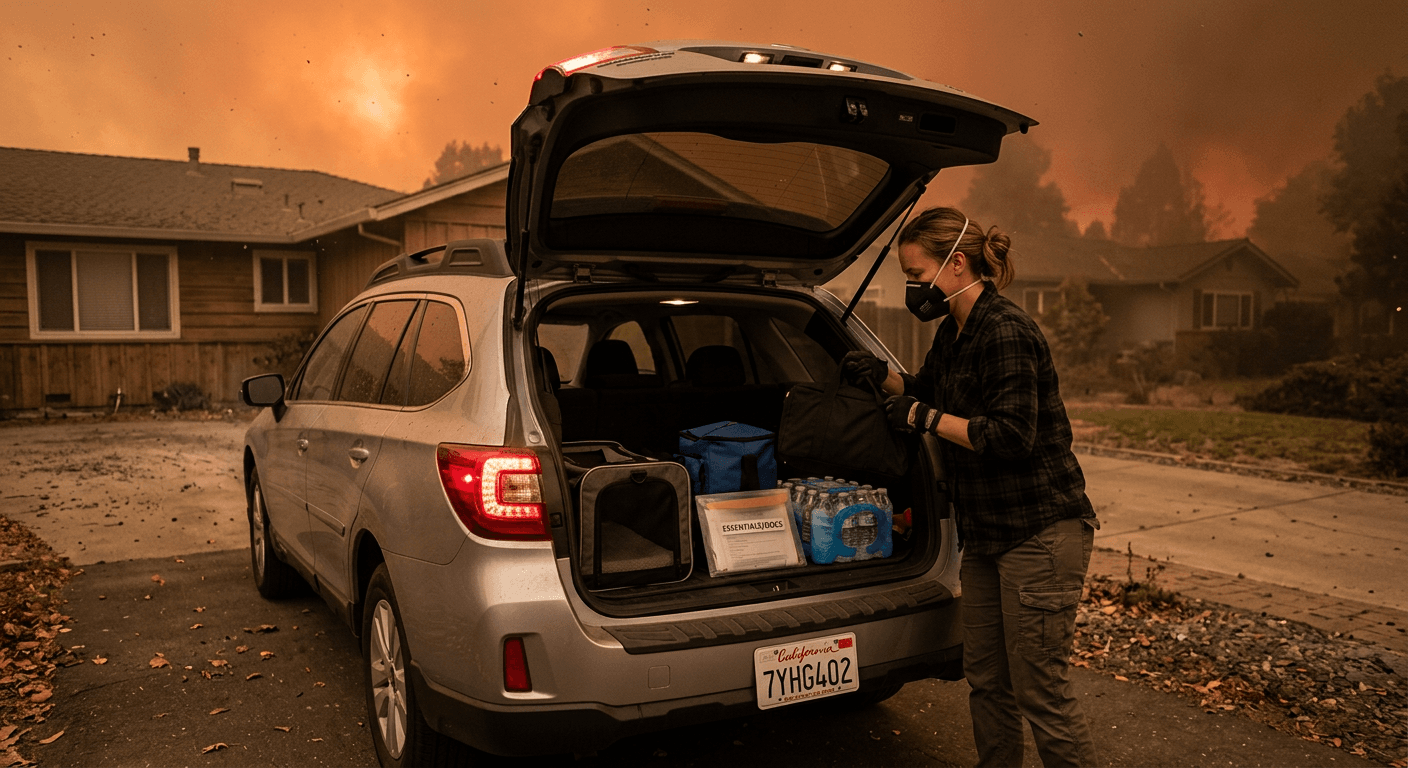
Start with what you cannot replace quickly. Identification, passports, wallets, phones, keys, medications, eyeglasses, and any critical medical items come first. After that, grab the bag that supports 24 to 72 hours away from home: chargers, power bank, water, simple food, spare clothes, hygiene basics, and cash.
The bag does not have to be exotic. Build it around the same ordinary essentials covered in escaping a city within 24 hours, then add wildfire-specific needs like masks appropriate for smoke guidance, pet carriers, route notes, and copies of insurance or property documents.
Then make room for the things that keep a family functional under stress: kids’ essentials, pet food, leash or carrier, and one small comfort item if it keeps a child calm in the car. That matters more than people admit.
What should you ignore? Most of the house. Do not burn ten minutes packing kitchen gadgets, random camping gear, or sentimental clutter you never prepared to move. If it was not ready before the alert, it is probably not worth the delay now.
The vehicle is part of the survival plan
A wildfire evacuation can fail before you even leave the driveway. Cars become shelters, storage, escape tools, and charging stations all at once. That means fuel matters, route choice matters, and loading discipline matters.
Do not assume your normal route is open. Recent fires have forced closures, warnings, and rapid changes in evacuation zones. Have a primary route and a second one. If you live in a fire-prone area, this should not be something you figure out while backing out of the driveway.
Load the car with the heavy essentials first. Do not create a pile of loose gear that shifts, blocks visibility, or forces you to repack under pressure. If you evacuate with pets, make sure carriers, leashes, and basic supplies are already accessible.
Smoke can be the first threat, not the fire
A lot of people picture evacuation as outrunning flames. In reality, smoke often reaches you first and starts degrading judgment before the fire is anywhere near the house. Air quality was bad enough during the recent Southern California fire that Moreno Valley College closed because of it.
That matters because smoke changes how you drive, how kids cope, and how long vulnerable people can stay in place. If someone in the household has asthma, heart disease, or is very young or very old, your threshold to leave should be lower. Wildfire is not only a flames problem. It is an air problem.
When to leave
Leave earlier than your pride wants to. That is the rule.
If an evacuation warning is issued and conditions are windy, hot, dry, or changing fast, treat that warning like the last calm moment you are going to get. The recent California fires spread quickly under those exact conditions, and containment improved only after winds eased.
People get trapped because they confuse “not ordered yet” with “safe.” Those are not the same thing.
The prepper lesson
Wildfire is one of the clearest examples of why preparedness is not gear collecting. It is compression. It is reducing your life into the small number of actions that still work under pressure.
If you want to be ready, do the boring work before the season gets ugly. Keep the car fueled. Keep documents together. Keep meds easy to grab. Keep pet gear in one place. Keep a real go-bag, not a fantasy one. North American fire outlooks are already signaling elevated activity in some areas, and early-season fires are a reminder that you do not get to choose the day your plan gets tested.
Twenty minutes is enough if your system is already built. It is not enough if the evacuation alert is the first time you start thinking about evacuation.
Editorial note
Wildfire conditions can change quickly. This article supports household planning, but evacuation orders, local fire officials, and emergency alerts should take priority in a real event.
Article recap
- Wildfire evacuation is a time problem: people, pets, medication, documents, and transportation come before property.
- A car with fuel, known routes, and pre-packed essentials removes dangerous decisions under smoke and stress.
- Smoke, road closures, and changing winds can make waiting more dangerous than leaving early.
Sources and further reading
- Ready.gov: Wildfires — Ready.gov, accessed May 2026
- CDC: Wildfire Smoke and Your Patients' Health — Centers for Disease Control and Prevention, accessed Jun 2026
- Ready.gov: Build a Kit — Ready.gov, accessed Aug 2026
Read next


Questions readers askFrequently asked questions
People, pets, medications, IDs, wallets, phones, chargers, keys, eyeglasses or medical devices, and critical documents come first. If those are not ready, skip replaceable items and leave.
No. Smoke, wind, road congestion, and official evacuation notices may be enough reason to go before flames are visible. Waiting for certainty can close routes and expose you to heavier smoke.
Comments
Leave a comment
No comments yet. Be the first to comment!