
Water & food
How to Pack White Rice in Mylar Bags
Start with a small batch you can finish without rushing. This sequence is for plain, uncooked, commercially dry polished white rice from a reliable supplier,...
Quick answer
Start only with suitable plain, uncooked, commercially dry polished white rice from a reliable supplier and a known dry storage history. Match the food-contact bag, heat sealer and food-safe absorber instructions before opening packets. Label and fill a small batch, add the specified intact packets inside each bag, complete the heat seal and cooling stage, then inspect and protect the bags. Packing does not sterilize food or make damp or uncertain food safe.
Start with a small batch you can finish without rushing. This sequence is for plain, uncooked, commercially dry polished white rice from a reliable supplier, in an intact package with a known dry storage history. It is not a method for every food sold as “dried.”
Rice still needs safe water and cooking resources. Keep separate ready-to-eat supplies for times when cooking is unavailable; our emergency grocery guide covers that different job. Packing rice does not turn it into a complete emergency diet.
1. Check the rice before removing oxygen
Utah State University Extension's white-rice guidance supports Mylar-type bags and food-safe oxygen absorbers for white rice. Inspect the original package and rice for damage, moisture, insects, discoloration or contamination before proceeding. Do not use this workflow for brown rice, mixed meals, cooked or ready-to-eat rice, home-dried meat or fruit, or home-freeze-dried foods.
Low oxygen is not a safety treatment. USU's Food Storage Booklet, printed page 42, warns that moist products in reduced-oxygen packaging can cause botulism. Its “about 10 percent or less” moisture qualification is not a home test or a universal safety guarantee. Dry feel, a snapping sound or a kitchen-scale experiment cannot certify a different food for this process. If the food's identity or dry storage history is uncertain, stop rather than trying to dry it for packing.
Retain or photograph the original brand and product name, ingredient and allergen information, printed date with its wording, lot code, UPC and storage and cooking directions. Keep that record linked to the bags. Repacking, oxygen absorbers and vacuum sealing do not sterilize food, rescue a compromised batch or reset its age.
2. Match the bag, sealer and absorber instructions
Before opening anything, gather new, intact food-contact foil-laminate bags for this use, a compatible heat sealer, food-safe oxygen absorbers, a marker, clean dry utensils and upright supports. For packaging selection, start with choosing dry-food storage containers.
Read the three sets of instructions together. Confirm the sealer can handle the exact film and bag width, the required sealing space and final closure, and the machine's heating and cooling procedure. Confirm absorber capacity and quantity for this rice, actual fill and remaining air, including air between grains as well as above them. IMPAK's capacity guidance distinguishes foods by density; bag size alone is not a universal dose rule.
Find the packet maker's exposure limits, any indicator instructions and approved storage method for unused packets. Do not infer packet condition from warmth or softness, or assume every brand uses the same indicator colors. If the documents leave capacity, compatibility or operating steps unclear, ask the supplier before opening the absorber master pack. Do not borrow a setting from a similar-looking bag or machine.
3. Label and fill a manageable batch
Choose portions you can use conveniently after opening, not the largest bags you can lift. Prepare a clean, dry work area and clean hands and utensils. Keep water and unrelated food preparation away from the session. Do not rinse the rice or heat it to dry it as a packing step.
Label each empty bag with “uncooked white rice,” the packing date and a batch identifier tied to the original-label record. Keep writing clear of the sealing path. PackFreshUSA's packing guide puts labeling and filling before opening the absorber supply, a useful way to avoid searching for a pen while packets are exposed.
Support bags upright and fill them without spilling grains or dust into the closure. Leave the clear top space required by the actual bag and sealer, not a generic headspace measurement. Keep that path clean, dry and free of wrinkles. Remove some rice if the top cannot align as instructed; do not force an overfilled bag closed.
Stage the filled bags, ready-to-use sealer and maker-approved storage for unused absorbers before opening the master pack. Choose a batch you can complete within the packet maker's handling instructions without rushing.
4. Add packets and complete the heat seal
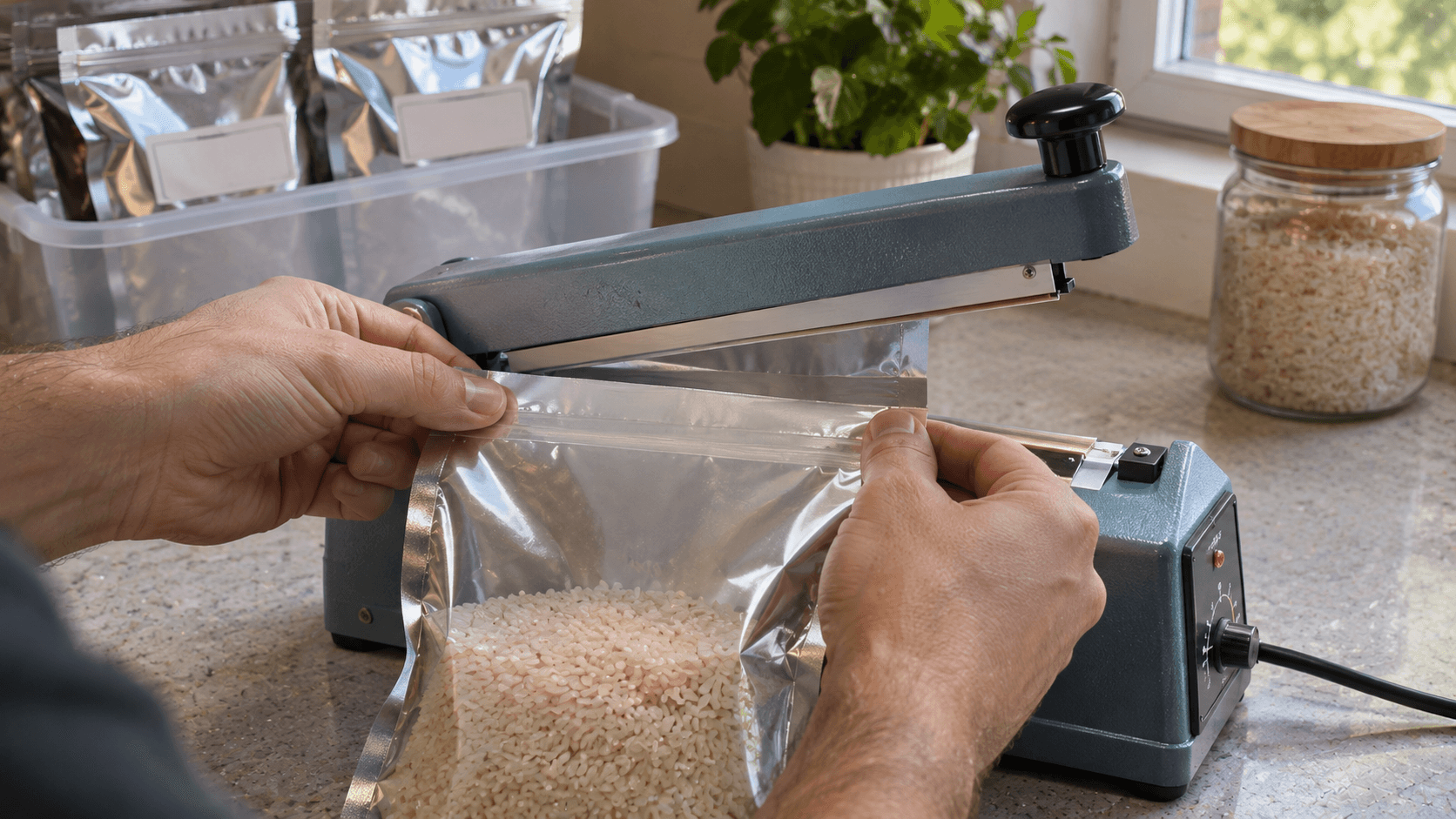
Open the absorber master pack only when everything is ready. Following the documented quantity and handling instructions, place intact food-contact packets inside each rice bag. Do not cut packets open. PackFreshUSA's oxygen-absorber Q&A explains that its packets belong inside the heat-sealed bag; a packet sitting in the outer bucket is not a substitute. Promptly protect unused packets by their maker's approved method, rather than leaving them on the counter.
Align the clean sealing area and make the complete edge-to-edge heat seal using the matched bag and machine instructions. Do not assume a zipper is the final reserve barrier closure. For example, IMPAK's specified ZipSeal foil pouch closes with a zipper, but its maker recommends heat sealing to secure the closure and maximize barrier properties. Follow the actual pouch's closure layout.
Complete any required cooling or hold stage before lifting, bending or inspecting the seam. The IMPAK IPK sealer manual, section 5, includes a cooling hold after heating; its settings and timing are not instructions for other machines. USU's booklet, printed page 28, advises against clothes-iron sealing because of poor seals. Use a documented compatible heat sealer, not an iron shortcut or an improvised vacuum-sealer adaptation.
5. Inspect the seam, not the vacuum look
After the specified cooling stage, examine both bag surfaces for holes and handling damage. Follow the entire seal from edge to edge. PackFreshUSA's seal-inspection guidance identifies gaps, wrinkles and trapped food as defects to check. The seam should be continuous and uniform, not merely attached at a few points.
These checks can reveal defects, but cannot measure residual oxygen or prove food safety. Absorbers remove oxygen, not all the air. A bag need not become brick-hard, and a tight-looking bag is not proof of success. Do not use bag contraction as your acceptance test.
Keep a defective bag out of finished stock. If a seal fails during this clean packing session, stop and consult the maker's troubleshooting and repacking instructions before proceeding. Do not treat adding another absorber and resealing as a rescue for unknown moisture, exposure or storage history.
6. Protect, record and use the batch
Only put fully sealed, cooled and inspected bags away. Place them in a clean, dry protective outer bin with a secure lid, without crushing the bags or bending seams under heavy loads. Keep the batch cool, dry and dark, away from household chemicals. The outer container helps protect against punctures and pests, but plastic is not a guarantee against rodents.
Keep a short batch record. For example, “Pantry rice A” can connect the labeled bags and their count and portion size to the saved retail label, packing date and shelf location. Add the bag and absorber product identities, the manufacturer's sealing procedure you used and the inspection result. This is a traceability record, not a laboratory safety certificate or a new expiration date.
Check the bin and bags when accessing supplies and during ordinary inventory reviews. Look for pest signs, punctures, damaged seams or moisture. Remove suspect bags from usable stock. University of Maryland Extension advises discarding infested food; discard moldy food too. Do not taste-test, redry, freeze or reseal an uncertain batch to salvage it. Choose disposal or specific Extension advice when safety is unclear. As the FDA cautions, food can be unsafe without looking, smelling or tasting spoiled.
When opening a sound bag, keep absorber packets out of the meal and follow the retained rice storage and cooking directions. Add the bags to your normal food-rotation system so using a portion leads to a deliberate replacement, not an anonymous bag left indefinitely at the back of a shelf.
Editorial note
This procedure is limited to a suitable plain white-rice batch and documented compatible packaging supplies. Extension and FDA guidance set the food-safety boundaries; manufacturer documents support only their stated handling and closure details, not universal settings or shelf-life promises. A visual seal check cannot verify oxygen levels or biological safety. For uncertain food or storage history, seek specific Extension advice or discard the food.
Article recap
- Keep original food identity, lot, date wording and cooking directions linked to every packing batch. Repacking does not reset product age.
- Prepare filled bags and approved unused-packet storage before opening absorbers. Use the exact matched bag, sealer and absorber instructions, not generic settings or dose tables.
- Complete and inspect the full heat seal before storing. Bag tightness does not prove oxygen removal or safety; discard compromised food rather than trying to rescue it.
Sources and further reading
- Utah State University Extension: Storing White Rice
- Utah State University Extension: Food Storage Booklet
- PackFreshUSA: How to Seal Mylar Bags
- PackFreshUSA: Sealing Mylar Bags: Easy Methods Anyone Can Use
- PackFreshUSA: Q & A
- IMPAK Corporation: All About Oxygen Absorbers
- IMPAK Corporation: IPK Sealer Instruction Manual, Section 5
- IMPAK Corporation: Foil ZipSeal Pouch Material and Closure Specifications
- University of Maryland Extension: Kitchen and Pantry Pests
- FDA: Are You Storing Food Safely?
- National Center for Home Food Preservation: Packaging and Storing Dried Foods
- PackFreshUSA: Everything You Ever Wanted to Know About Oxygen Absorbers (But Were Afraid to Ask)
Read next

Questions readers askFrequently asked questions
Use the absorber maker's instructions for the exact food, bag and fill. Air above the rice and between grains matters, so bag volume alone does not establish a universal packet size or count. If the documentation does not cover your combination, ask the supplier before opening packets. Extra packets cannot make unsuitable or compromised food safe.
Do not assume so. Follow the exact pouch's final-closure instructions. For IMPAK's documented ZipSeal foil pouch, the maker recommends a heat seal to secure the closure and maximize its barrier properties even though the zipper closes the bag. Use compatible equipment and complete its cooling or hold stage; do not substitute zipper closure for the specified heat seal.
Not necessarily. Oxygen absorbers do not remove all air, so vacuum-like tightness is not a reliable pass/fail test. Neither a tight nor a loose appearance proves residual oxygen levels or food safety. Inspect the seam and bag for visible defects, check the documented packing procedure and investigate unexpected changes rather than adding packets based on appearance.
No. This workflow is limited to plain, uncooked, commercially dry polished white rice with a known dry storage history. Moist foods in reduced oxygen can pose a botulism risk. A dry feel or snap test does not establish suitability, and oxygen absorbers or vacuum sealing do not sterilize food or replace required refrigeration. Home-dried foods and mixed meals need their own validated food-specific guidance.
Comments
Leave a comment
No comments yet. Be the first to comment!