
Water & food
A Seven-Day Pantry Meal Plan for Two Adults
A shelf of ingredients is easier to use when each can has a meal attached. This seven-day pantry meal plan covers two adults' breakfasts, lunches, dinners an...
Quick answer
For two adults, use the seven-day menu and buy the listed package counts, checking real net weights and yields. You need a working stove, potable water and refrigerator. The amounts illustrate shopping math, not a verified calorie or complete nutritional ration; adjust portions and retally before relying on them.
A shelf of ingredients is easier to use when each can has a meal attached. This seven-day pantry meal plan covers two adults' breakfasts, lunches, dinners and daily snacks. Eat the sequence or spread meals across ordinary weeks.
These are illustrative portions, not tested recipes or a verified calorie or nutritionally complete ration. Appetite, activity and health needs vary. Adjust amounts before relying on the plan and add extra food to the tally.
Before you shop
You need a working stove, potable water, cookware, can opener and working refrigerator. Ingredients are pantry-stable UNOPENED, not automatically after opening or cooking. This is not a no-cook blackout menu. If utilities or refrigeration fail, switch plans; see our food safety during a power outage guide.
Choose commercially fully cooked canned beans, chickpeas, chicken and salmon. Follow package cooking and after-opening storage directions. Package sizes below are examples, not checked retail offers. Check ingredient and allergen labels.
Portion key
Breakfast and snack amounts are per person. Menu can counts are for BOTH adults together; share each listed can.
Oatmeal breakfast: 40 g (about 1.4 oz) dry oats, 16 g (0.56 oz) peanut butter and 20 g (0.7 oz) raisins. Cook oats with potable water per label. Serve with 250 mL (8.45 US fl oz) shelf-stable milk and one 113 g (4 oz) fruit cup.
Cereal breakfast: 60 g (2.1 oz) whole-grain cereal, 250 mL (8.45 US fl oz) milk and one 113 g (4 oz) fruit cup.
Every lunch: 60 g (2.1 oz) crackers per person. Peanut-butter lunches add 32 g (1.1 oz) spread per person; other lunches split the named cans. For each chickpea lunch, dress the household portion with 15 mL (about 1 US tbsp) each oil and vinegar.
Every dinner: 85 g (3 oz) dry rice or pasta per person, plus the household cans listed below. Use 15 mL (about 1 US tbsp) oil per dinner except the coconut curry. Allow 5 mL (about 1 tsp) dried seasoning for each two-person dinner, not a spoonful of salt.
Every day's snack: 28 g (about 1 oz) nuts and one 113 g (4 oz) fruit cup per person. This is separate from breakfast fruit: four individual fruit cups per household per day.
The seven-day menu
Use the portion key daily. Drain canned solids as appropriate; keep tomatoes and coconut milk for sauces. Cook rice and pasta in potable water per label. Warm dinner toppings separately, adding water if needed; serve with the grain. Assemble lunches at mealtime. No meal relies on opened-can or cooked-grain carryover.
1. Bean rice and chickpea crackers
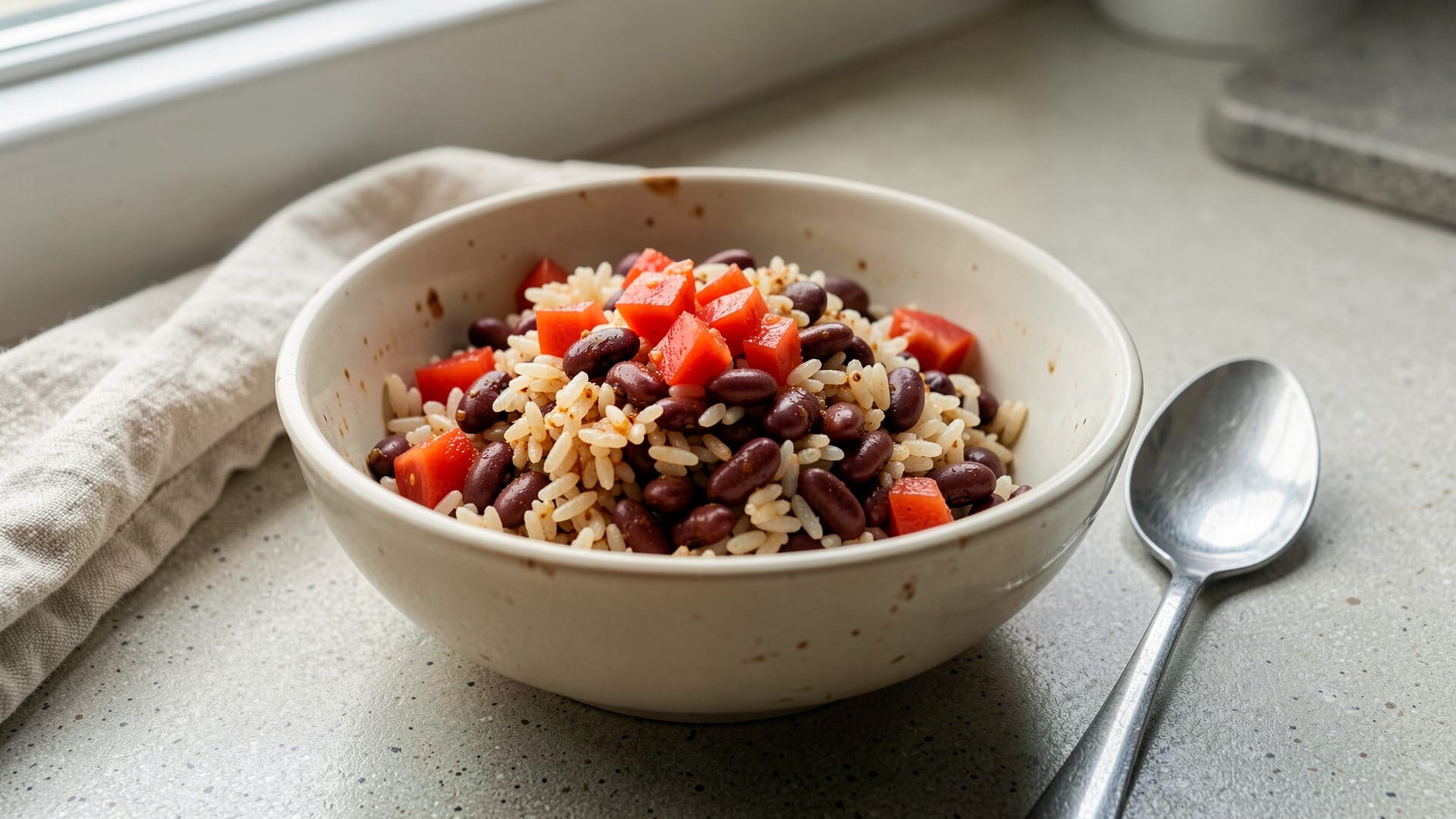
Breakfast: peanut-butter raisin oatmeal. Lunch: mash one can chickpeas with one can vegetables, oil and vinegar; serve with crackers. Dinner: rice with one can black beans, one can tomatoes and one can vegetables, plus oil and cumin. Snack: nuts and fruit cups.
2. Chicken tomato pasta
Breakfast: cereal, milk and fruit. Lunch: one can chicken and one can vegetables with crackers. Dinner: pasta with a separate can chicken, one can tomatoes and one can vegetables, plus oil and dried herbs. Snack: nuts and fruit cups.
3. Coconut chickpea curry
Breakfast: peanut-butter raisin oatmeal. Lunch: peanut-butter crackers. Dinner: rice with one can chickpeas, one can coconut milk and one can vegetables; use curry seasoning and no added oil. Snack: nuts and fruit cups.
4. Salmon lunch and white-bean pasta
Breakfast: cereal, milk and fruit. Lunch: one can salmon and one can vegetables with crackers. Dinner: pasta with one can white beans, one can tomatoes and one can vegetables, plus oil and dried herbs. Snack: nuts and fruit cups.
5. Chili-spiced black-bean rice
Breakfast: peanut-butter raisin oatmeal. Lunch: one can chickpeas and one can vegetables with crackers, oil and vinegar, as on Day 1. Dinner: rice with one can black beans, one can tomatoes and one can vegetables, plus oil and chili seasoning. Snack: nuts and fruit cups.
6. Chicken vegetable rice
Breakfast: cereal, milk and fruit. Lunch: peanut-butter crackers. Dinner: rice with one can chicken and one can vegetables, plus oil and dried herbs. Snack: nuts and fruit cups.
7. Garlic white-bean pasta
Breakfast: peanut-butter raisin oatmeal. Lunch: peanut-butter crackers. Dinner: pasta with one can white beans, one can tomatoes and one can vegetables, plus oil and garlic seasoning. Snack: nuts and fruit cups.
Shopping list for both adults
Subtract suitable food you own. Grams and milliliters govern calculations; US equivalents are approximate. Canned weights are NET, not drained solids or promised yields. Check actual yields and increase purchases if portions are too small.
Dry goods and spreads
Oats: need 320 g (11.3 oz). Buy one 510 g (18 oz) canister; 190 g remains.
Cereal: need 360 g (12.7 oz). Buy one 425 g (15 oz) box; 65 g remains.
Crackers: need 840 g (29.6 oz). Buy two 454 g (16 oz) boxes; 68 g remains.
Rice: need 680 g (24 oz). Buy one 907 g (2 lb) bag; 227 g remains.
Pasta: need 510 g (18 oz). Buy two 454 g (16 oz) boxes; 398 g remains.
Peanut butter: need 320 g (11.3 oz). Buy one 454 g (16 oz) jar; 134 g remains.
Raisins: need 160 g (5.6 oz). Buy one 170 g (6 oz) bag; 10 g remains.
Nuts: need 392 g (13.8 oz). Buy one 454 g (16 oz) bag; 62 g remains.
Canned meal ingredients
Buy three cans chickpeas, two black beans and two white beans, each 425 g (15 oz) net.
Buy eleven cans vegetables, each 425 g (15 oz) net: for example, four carrots, three green beans, two peas and two corn. Tomatoes are additional.
Buy five cans tomatoes, each 425 g (15 oz) net.
Buy three cans fully cooked chicken, each 354 g (12.5 oz) net, and one can fully cooked salmon, 142 g (5 oz) net.
Buy one can coconut milk, 383 g (13.5 oz) net. All these cans are used fully within their assigned meals; there are no planned can remainders.
Milk, fruit and flavorings
Milk: need 3,500 mL (about 118.3 US fl oz). Buy fourteen 250 mL (8.45 US fl oz) shelf-stable cartons; no remainder. An 8 US fl oz carton is about 237 mL, not 250 mL: buy enough for 3,500 mL or change portions and retally. Follow after-opening directions for larger cartons.
Fruit: buy 28 individual 113 g (4 oz) cups, or seven four-packs. All are used. A product called a fruit cup is not a measuring-cup serving.
Oil: need 120 mL (about 4.1 US fl oz). Buy one 250 mL (8.45 US fl oz) bottle; 130 mL remains.
Vinegar: need 30 mL (about 1 US fl oz). Buy one 250 mL (8.45 US fl oz) bottle; 220 mL remains.
Seasonings: set aside 35 mL (about 7 tsp) total from suitable jars of cumin, herbs, curry, chili and garlic seasoning. The mix is your choice. No fresh toppings or extra seasonings are required in the tally.
Cooking, rinsing and cleanup water is additional. Measure needs during a kitchen trial; this is not an emergency drinking-water allowance.
After opening and cooking
Follow NDSU Extension's packaged-food guidance: do not use leaking, bulging or sharply dented cans, cracked jars or broken seals. A best-before date describes quality, not a safety guarantee.
Serve promptly and refrigerate leftovers promptly in smaller covered containers. Illinois Extension's leftovers guidance specifies reheating to at least 165°F (74°C). Follow product instructions and current food-safety guidance. Store dry goods, spreads and oil as labels require.
Make it part of normal groceries
Try one breakfast and dinner before buying the week, then adjust portions and purchases. The UF/IFAS preparedness cookbook also recommends a recipe trial.
Put bean rice on one week's menu and chicken pasta on another. Remainders are not another complete week. Use our emergency-food rotation routine for replacement purchases. Retally any swaps. Seek individualized advice for medical diets; this is not a child or infant feeding plan.
Editorial note
This menu is an editorial shopping example, not a cooking test, individualized diet or verified calorie ration. Package sizes and portions are illustrative; actual labels, yields and household needs govern purchases and preparation. Food-safety guidance is drawn from the linked Extension sources.
Article recap
- The menu covers seven breakfasts, lunches, dinners and daily snacks for two adults, with package counts and remainders.
- A working stove, potable water and refrigerator are required. Shelf-stable describes the ingredients unopened.
- The portions are examples, not a complete nutritional ration. Adjust for appetite, activity and health needs, then retally.
- Check actual labels and net weights, especially milk cartons. Try a breakfast and dinner before buying the full week.
Sources and further reading
- Questions and Answers About Storing Canned and Packaged Food — North Dakota State University Extension, accessed Oct 2026
- Leftovers — University of Illinois Extension, accessed Oct 2026
- EFNEP Preparedness and Resiliency Cookbook — University of Florida IFAS / EFNEP multi-university workgroup, accessed Oct 2026
Read next
Questions readers askFrequently asked questions
No. It assumes a working stove, potable water and reliable refrigeration. Ingredients are shelf-stable unopened, not automatically after opening or cooking. Use a separate plan if those kitchen conditions fail; see our power-outage food-safety guide.
First choose portions that suit each person. Add the ingredient amounts across every meal, then divide each total by the actual package quantity and round purchases up to whole packages. Recalculate remainders. Multiplying this adult example does not establish calorie or nutritional adequacy, especially for children or medical diets.
Yes, but check ingredient and allergen labels, net weight, drained yield, cooking directions and after-opening storage. Retally the affected meals and packages. A 250 mL carton is about 8.45 US fl oz; an 8 US fl oz carton is only about 237 mL. Substitutions are not automatically equivalent portions or nutrition.
Comments
Leave a comment
No comments yet. Be the first to comment!