Collapse & conflict
How Self-Sufficient Can You Really Be? Lessons from Vaclav Smil
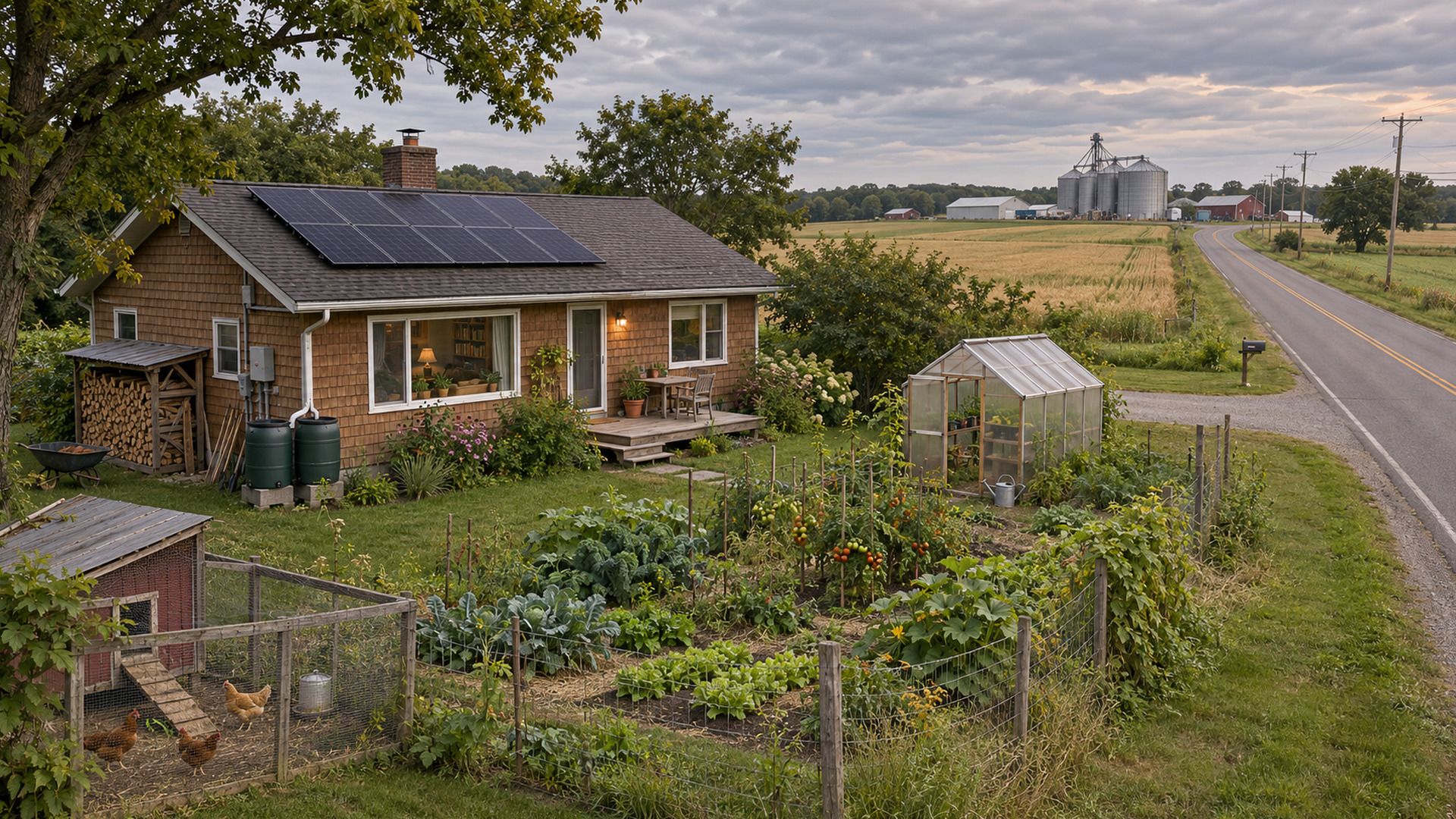
Imagine a home on a bright afternoon: solar panels on the roof, a battery in the utility room and vegetables growing outside. The lights are on. The owner ca...
Quick answer
Partial self-sufficiency can be useful. A home may produce electricity or some food while still relying on manufactured parts, inputs and services. Judge an independence claim by the service it covers, its operating conditions and the outside support still needed. Industrial dependence is not a household failure countdown.
Imagine a home on a bright afternoon: solar panels on the roof, a battery in the utility room and vegetables growing outside. The lights are on. The owner calls it self-sufficient.
Now imagine asking one awkward question: who makes the replacement inverter?
Nothing has broken in this example. There is no disaster on the horizon. But the question reveals a distinction that a sunny roof can hide. A household can produce something it needs while still relying on a much larger world to keep that capability available.
Self-sufficient at what?
Vaclav Smil studies the connections between energy, food and the material world. His How the World Really Works covers those subjects and their global connections, according to its publisher. They are a useful starting point for looking beyond the equipment visible at home.
In his March 2026 commentary contributed to Michael Cembalest's J.P. Morgan energy paper, Smil draws attention to fossil resources used as industrial raw materials, not only burned for energy. That is an argument about how production works, not a prediction that your household supplies are about to disappear.
Here is our household application: separate operating a system from replenishing its inputs and replacing its equipment. Making electricity today, getting through an outage and reproducing the machinery that makes electricity are different achievements. Calling all three “independence” makes a useful improvement sound like an unlimited promise.
Follow the panel back past the roof
Start with an ordinary crystalline-silicon solar panel. Before it became a rectangle above the gutter, its silicon passed through an industrial chain. The Department of Energy's manufacturing explanation follows that chain from quartz-derived silicon to high-purity polysilicon, wafers and solar cells.
The finished module also brings together glass, polymer layers, metal connections and, typically, an aluminum frame. The inverter involves another production chain: electronic components assembled on a circuit board. Sunlight is local. The equipment that turns it into usable household power is manufactured.
Those materials are not daily fuel deliveries. A panel does not need a new shipment of silicon each morning. The distinction matters because upstream dependence does not cancel the benefit of generating power where you use it.
DOE's solar resilience guidance explains that solar paired with storage can help during outages. The installed configuration matters; panels alone do not establish backup capability. A suitable system can reduce dependence on a working grid without making its owner independent of parts, manufacturers or qualified service.
For the design questions, see what home solar backup can actually support. The point here is different: an installation can buy useful operating freedom without bringing its entire factory home.
The garden has a different boundary
Now walk from the roof to the vegetable bed. Growing some food yourself is a real change in where that food comes from. It is not automatically the same as replacing the food system that supplies the rest of your meals.
At industrial scale, one important connection runs through nitrogen. The International Energy Agency's 2021 ammonia roadmap explains that ammonia is the starting material for mineral nitrogen fertilizers. In the fossil-based production routes it describes, fossil resources do two jobs: they supply chemical feedstock for hydrogen as well as energy for the process. Replacing the heat source and replacing the raw material are separate problems.
That does not mean every backyard needs a bag of synthetic fertilizer. Oregon State University Extension's regional gardening guide notes that a history of repeated compost or manure additions can reduce or eliminate fertilizer needs. Soil and nutrient history matter; that observation is not a universal application recommendation.
The useful question is what your particular harvest replaces and what it still draws on. A basket of homegrown vegetables need not provide a complete diet to be worthwhile. Nor does a successful harvest, by itself, establish a household's ability to feed everyone through every season.
For a broader look at food origins, dietary needs and environmental questions, Smil's How to Feed the World is relevant further reading based on its publisher's description. It is not a garden preparedness plan, and we are not presenting it as one.
Oil can arrive without a fuel tank
Back inside, consider the plastic housing of an appliance. It illustrates another way industrial inputs reach a home: as materials rather than fuel you pour or burn.
The U.S. Energy Information Administration explains that petroleum is a feedstock for products including plastics, polyurethane and solvents. Its uses extend beyond transportation and heating. Switching a household appliance to locally generated electricity changes its power supply; that change alone says nothing about how its housing was made.
This is the easily missed part of Smil's argument. A home can reduce the fuel it consumes directly while remaining connected to industries using fossil resources upstream. It does not follow that every plastic item has identical origins, or that alternative materials and production routes are impossible.
It also does not follow that you should buy a lifetime supply of everything. A material connection tells you something about production. It does not tell you when a supplier will fail, whether a part will be unavailable or how long a particular device will last.
A dependence is not a countdown
Smil's 2026 commentary also explicitly welcomes the efficiency gains from electric vehicles and heat pumps. His concern about industrial constraints should not be flattened into “renewables do not work.” The IEA roadmap, too, describes alternative ammonia production pathways, including electrolysis-based production. Today's supply chain is not a law fixing every future one.
The more useful habit is to ask what a claim actually measures. Penguin describes Smil's Numbers Tell Stories as an examination of how statistics can challenge familiar narratives. Our application to preparedness is simple: before accepting “self-sufficient,” ask which service, under which conditions, and with what remaining outside support.
A smaller promise can be a better one
Return to the imagined home. “This installed system supports these electrical needs within its documented limits” is less glamorous than “we are independent.” It is also something a qualified installer can explain and a household can plan around.
Ask the provider of one important system who supports it and what the approved repair or replacement route is. That is a conversation, not an invitation to open a battery or improvise electrical repairs. If it reveals a consequential gap, use our guide to choose your household preparedness priorities rather than starting another shopping list.
You do not have to recreate an industrial civilization in your backyard to become less exposed to a disruption. The useful gain is a specific dependence reduced, with the remaining connections understood. The lights in that imagined home still count. So does knowing what keeps them possible.
Editorial note
The household interpretation is ours, not a preparedness plan endorsed by Smil. His author announcement identifies the cited contribution. Book links are non-affiliate publisher pages; their descriptions, not complete books, informed the further-reading suggestions.
Article recap
- Making electricity, replenishing inputs and replacing equipment are different kinds of independence.
- Solar backup and homegrown food can be useful without making a household independent of industrial supply chains.
- Ask what a self-sufficiency claim covers and what support remains. A production dependency is not a crisis timetable.
Sources and further reading
- Fighting Words — Vaclav Smil, accessed Nov 2026
- Fighting Words: 16th Annual Eye on the Market Energy Paper, Essential charts: Vaclav Smil on the limits and constraints on green electrification — J.P. Morgan; Michael Cembalest with attributed Vaclav Smil commentary, accessed Nov 2026
- Solar Photovoltaic Manufacturing Basics — U.S. Department of Energy, accessed Nov 2026
- Ammonia Technology Roadmap: Executive Summary — International Energy Agency, accessed Nov 2026
- Use of oil — U.S. Energy Information Administration, accessed Nov 2026
- Solar and Resilience Basics — U.S. Department of Energy, accessed Oct 2026
- Vegetable Gardening in Oregon (EC 871) — Oregon State University Extension Service; James R. Baggett, Deborah Kean, Dan M. Sullivan, Alexandra Stone and James Myers, accessed Nov 2026
- How the World Really Works — Penguin Books UK, accessed Nov 2026
- How to Feed the World — Penguin Books UK, accessed Nov 2026
- Numbers Tell Stories — Penguin Books UK, accessed Nov 2026
Read next



Questions readers askFrequently asked questions
Yes. Producing some electricity or growing some food can reduce a specific dependence without replacing every outside input. Describe the service gained, its conditions and its remaining support needs rather than treating independence as all or nothing.
No. Manufacturing inputs are not daily fuel deliveries. Appropriately configured solar and storage can provide useful outage backup while still depending on manufactured components and qualified service. Capability and limits belong to the particular installed design, not to the presence of panels alone.
No. A global mineral-nitrogen production chain does not establish the requirements of each garden. Soil and nutrient history matter, and the cited Oregon State guidance notes that repeated compost or manure additions can reduce or eliminate fertilizer needs in context. This is not a universal nutrient or application prescription.
No household failure date follows from the evidence discussed here. His cited 2026 contribution addresses energy-transition constraints and industrial uses of fossil resources. Our household interpretation concerns the boundaries of self-sufficiency claims, not a crisis timetable or a plan endorsed by Smil.
Comments
Leave a comment
No comments yet. Be the first to comment!