Collapse & conflict
What Europe's 72-Hour Preparedness Advice Actually Means
A cupboard full of tins is less useful if nobody can find the opener. That small gap captures the point of household preparedness: making ordinary life worka...
Quick answer
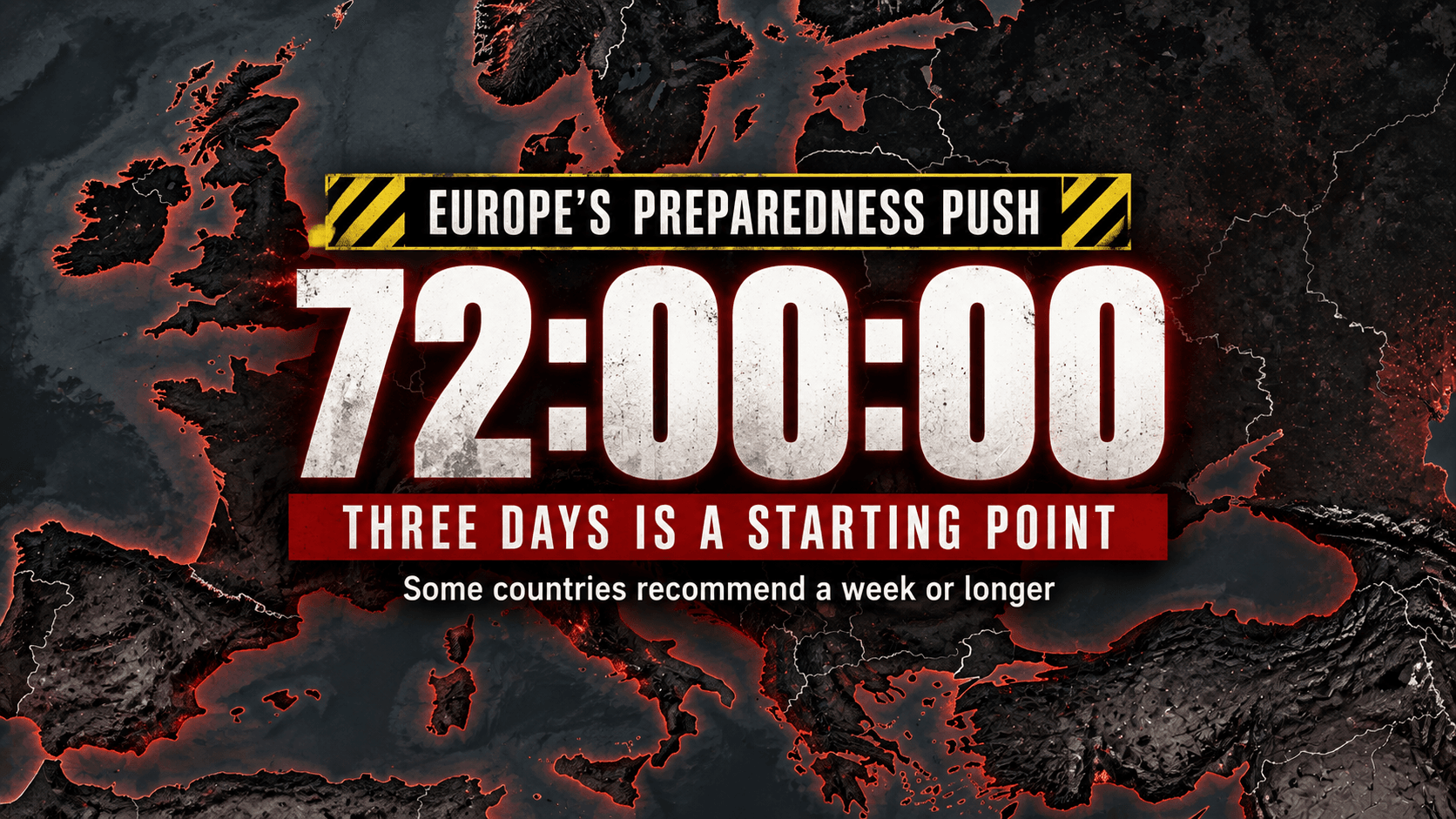
The UK, Belgium, Netherlands and Denmark recommend three days of household preparedness. Sweden recommends at least one week, Norway one week, and Germany ideally ten days, with three days a useful start. Follow your local guidance, check what water figures cover, and arrange support as well as supplies. None of these durations guarantees when services will return.
Affiliate disclosure
This article may contain affiliate links. If you buy through these links, The Survival Nexus may earn a commission at no extra cost to you. We recommend product categories and buying criteria that fit the emergency scenario described. Read our disclosure.
A cupboard full of tins is less useful if nobody can find the opener. That small gap captures the point of household preparedness: making ordinary life workable when familiar services stop working.
The UK's Be Ready launch on 22 October 2026 and Belgium's new practical brochure on 1 October 2026 are useful reasons to check those gaps. Neither announcement establishes that a particular crisis is imminent. Nor is there one European rule: four countries below recommend three days, two recommend a week, and Germany sets a longer aim.
What seven countries actually recommend
United Kingdom. The Cabinet Office's Be Ready checklist asks households to prepare for three days. Familiar food needing no cooking or refrigeration, drinking water, a torch, radio, phone charging and paper contacts are central. The October campaign updates messaging and branding, not the existence of household advice: the government has published it since May 2024.
Belgium. The National Crisis Center recommends at least three days of self-sufficiency. Its especially useful distinction is between supplies kept at home and a bag you can carry away. A small bottle in an evacuation bag is not the household's full water reserve. October's brochure is the second phase of the wider Prepared Together campaign, not a reason to buy everything at once.
Netherlands. The government's Denk vooruit kit guidance covers the first 72 hours. It points out that many supplies are probably already at home and asks readers to check them every six months. Gathering scattered items and knowing where they are can be more useful than buying another sealed kit.
Denmark. The official three-day guidance emphasizes familiar food, water, warmth, information and essential personal needs. It explicitly recognizes that preparing with friends, family or neighbours may make more sense for people with limited space, money or mobility. Shared preparation counts.
Sweden. The Swedish Civil Defence and Resilience Agency says to plan for at least one week of water, food, communication and heating. Its one-week recommendation dates to a 2020 policy decision, with “at least” wording used since 2024. Describing Sweden's current target as 72 hours understates it.
Norway. The Directorate for Civil Protection, DSB, recommends one week. One revealing detail is its advice about a DAB radio for emergency information. A radio bought for another country's broadcasts is not automatically the right local receiver. Its “emergency friend” idea also makes help with water, transport or a warm place part of the plan.
Germany. The Federal Office of Civil Protection and Disaster Assistance, BBK, says households should ideally manage for ten days. The same guide says supplies for at least three days already help greatly and can be built on gradually. Three days is a useful start, not Germany's maximum recommendation.
A buffer, not a countdown
The UK explains the purpose plainly: managing for three days helps while support reaches those most in need. Denmark similarly describes giving authorities room to stabilize the situation and help where need is greatest. Neither is a promise that your tap, payment terminal or mobile network will work again at hour 72.
There is also an EU-level initiative. The Preparedness Union Strategy launched on 26 March 2025 encourages essential supplies for at least 72 hours; the strategy text proposes guidelines for Member States. That is not an identical household order across Europe. The UK and Norway are European examples here, not EU members.
Start with your own national and local advice. Follow emergency instructions and evacuate when directed; a home reserve is not a reason to stay somewhere unsafe or delay urgent help.
Read the water allowance twice
Similar numbers can describe different needs. The UK specifies about 0.8 U.S. gallon (3 liters) per person per day for drinking only, with more for cooking and washing. Denmark's same daily quantity covers drinking and food preparation. Belgium gives about 0.8 to 2.6 U.S. gallons (3 to 10 liters) per person per day across a broader range of uses, including washing, toilet use and cooking.
Those figures are not interchangeable promises of full household water service. Read what your local allowance includes, then consider your food choices, personal needs and pets. For storage logistics, our guide to keeping water in a small home can help. Put suitable containers where the intended person can reach and lift them, not merely where they fit.
Turn the advice into one ordinary evening
Imagine two adults in a small flat preparing gradually. They begin with food they already eat: can each person open and eat a familiar meal without electricity, refrigeration or extra cooking water? Dry pasta may keep well, but it does not solve that particular problem. An accessible ready-to-eat meal might.
Next they put the existing torch, charged power bank and correct phone cable somewhere both can find. They write down a trusted contact and agree what to do if calls fail, including who could safely check in. They identify their local warning channel and a suitable radio service. A charged phone alone does not establish that the network will be available.
They also agree who could help carry water or offer somewhere warm. Someone who needs that help can make the call now; someone able to offer it can make a specific offer rather than “let me know.” A modest cash backup may help with card-payment disruptions, but cannot make a closed shop reopen.
If either person depends on powered medical equipment, the next step is an individual plan with their care team and equipment provider, not an assumption that a phone power bank will suffice. Support and continuity of care matter more than completing a generic shopping list.
Two small tools, only if there is a real gap
Use suitable equipment you already own first. These optional examples link to Amazon.com; equivalent locally available items are fine. As an Amazon Associate, The Survival Nexus earns from qualifying purchases. These are not government-endorsed products or hands-on test recommendations.
A Petzl TIKKINA headlamp can leave both hands free to retrieve supplies or read a paper plan. Petzl describes a wide beam for close-up use. Check that the intended user can operate it and keep compatible spare batteries; do not assume one set will last three days.
An EZ-DUZ-IT 3028 manual can opener addresses the easily missed step between stored tins and a meal. Manual still means hand strength and control, and cut edges can be sharp. Easy-open or otherwise accessible food may be better. HIC marks this model discontinued in its catalog, so treat it as an example, not an availability promise.
Finish by arranging one check-in, fixing one actual gap and setting a review reminder. The UK and Netherlands suggest six-month supply checks; follow each device's own charging instructions. For a calm check of equipment you already own, leave the electricity and essential devices on. The useful result is food you can access, information you can use and someone who knows the plan, not an impressive-looking box.
Editorial note
National guidance and product documentation checked on 30 October 2026. This comparison covers seven European countries, not every national or local requirement. Product examples are optional, not government endorsements or hands-on tests. Follow local alerts and arrange individualized support for medical and access needs.
Article recap
- Three days is a common starting point, not a single European standard or a recovery deadline.
- Water allowances have different scopes; distinguish drinking water, other household uses and a portable evacuation bag.
- Start with familiar food, usable equipment and a specific support agreement; buy only to fix a real gap.
Sources and further reading
- UK Cabinet Office: Be Ready household checklist
- Belgian National Crisis Center: Emergency kit at home
- Netherlands Government: Denk vooruit emergency kit
- Danish Emergency Management Agency: Prepared for crises
- Swedish Civil Defence and Resilience Agency: Home preparedness for at least a week
- Norwegian DSB: Self-preparedness questions and answers
- German BBK: Household emergency preparedness guide
- UK Cabinet Office: Be Ready campaign launch, 22 October 2026
- Belgian National Crisis Center: Prepared Together brochure launch, 1 October 2026
- European Commission and High Representative: Preparedness Union Strategy communication
- Petzl: TIKKINA headlamp specifications
- Steuby: EZ-DUZ-IT manual can opener
Read next
Questions readers askFrequently asked questions
No. The UK describes a household buffer while support reaches those most in need. It does not guarantee restored utilities or a visit at hour 72. Follow local emergency instructions and seek urgent help when needed.
No. Belgium explicitly separates supplies kept at home from a bag you can carry away quickly. A small amount of water in the bag is not the full home reserve. Evacuate when directed rather than trying to take every stored item.
Start with suitable things already at home and build gradually. Denmark recognizes preparation with family, friends or neighbours as a practical option. Agree specific help with check-ins, carrying water, transport or somewhere warm; preparation need not be done alone.
No. The UK lists drinking water separately from cooking and washing, while Denmark includes drinking and food preparation in its stated allowance. Belgium covers a broader range of uses. Read your own local guidance and account for household and pet needs instead of copying a number without its scope.
Comments
Leave a comment
No comments yet. Be the first to comment!