
Water & food
Should You Choose 5 or 7 Gallon Emergency Water Containers?
A seven-gallon (26.5-liter) jug holds about 58.4 pounds (26.5 kilograms) of water before you count the jug. Five gallons (18.9 liters) reduces that to 41.7 p...
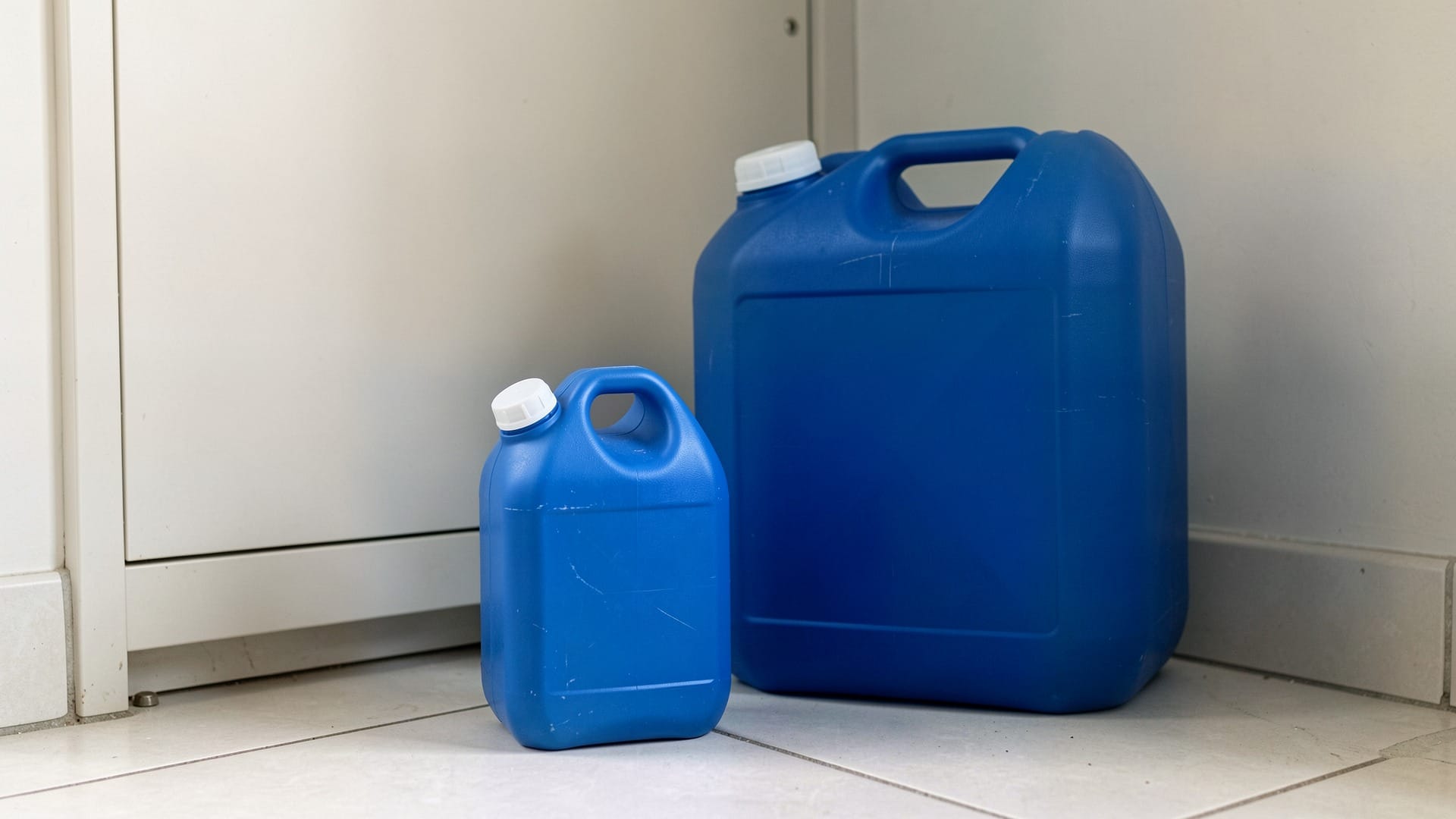
Quick answer
Choose seven gallons only if you can fill, position, dispense from and maintain the full container. Five gallons reduces the water load from about 58.4 pounds (26.5 kilograms) to 41.7 pounds (18.9 kilograms), before the jug itself. If neither works, divide the same reserve among smaller units or sealed bottles.
A seven-gallon (26.5-liter) jug holds about 58.4 pounds (26.5 kilograms) of water before you count the jug. Five gallons (18.9 liters) reduces that to 41.7 pounds (18.9 kilograms). Neither size becomes easy to use just because it has a handle.
Compare how each size divides the same reserve and whether you can fill, store, serve from and maintain it. Choose your household quantity separately; our guide to emergency water storage for apartments covers amounts and placement. Here, the decision is how to package that water.
Start with the weight you will actually handle
USGS conversion factors put water at about 8.34 pounds per US gallon. All gallon figures below are US gallons, and the metric equivalents are approximate. These are water-only weights, not filled-container weights:
7 gallons (26.5 liters): 58.4 pounds (26.5 kilograms).
5 gallons (18.9 liters): 41.7 pounds (18.9 kilograms).
3.5 gallons (13.2 liters): 29.2 pounds (13.2 kilograms).
2.5 gallons (9.5 liters): 20.9 pounds (9.5 kilograms).
1 gallon (3.8 liters): 8.3 pounds (3.8 kilograms).
Moving from seven to five gallons removes about 16.7 pounds (7.6 kilograms) of water per container. Add the empty container's weight, also called tare, to either figure. For example, Reliance lists its seven-gallon Aqua-Tainer at 2 pounds (0.9 kilograms) empty. At a nominal seven-US-gallon (26.5-liter) fill, that calculates to about 60.4 pounds (27.4 kilograms) altogether. This is a calculation from published specifications, not a hands-on weighing.
There is no universal safe lifting limit. Grip, reach, balance, the handle and the route matter. A smaller container can still be unsuitable for a particular person or task.
Compare enough containers for the same reserve
Use 14 gallons (about 53 liters) as an illustrative comparison target, not a recommendation for your household's needs. Buying whole containers gives four ways to reach or exceed that target:
Two 7-gallon containers hold 14 gallons (53 liters). There are two containers to maintain, but each holds 58.4 pounds (26.5 kilograms) of water.
Three 5-gallon containers hold 15 gallons (56.8 liters). Each holds 41.7 pounds (18.9 kilograms) of water, with one more container to fill and inspect than the seven-gallon setup.
Four 3.5-gallon containers hold 14 gallons (53 liters). Each holds 29.2 pounds (13.2 kilograms) of water, spread across four separate units.
Six 2.5-gallon containers hold 15 gallons (56.8 liters). Each holds 20.9 pounds (9.5 kilograms) of water, with six containers and their closures to maintain.
Smaller units reduce the load of each move, not the weight of the reserve. Fourteen gallons still contains about 116.8 pounds (53 kilograms) of water, plus all the containers. The two 15-gallon options hold an extra gallon, so do not mistake their higher total weight for a disadvantage caused by container size alone.
If both sizes fit your handling needs, compare dimensions and care for the whole set. Two larger jugs mean fewer units, not automatically less floor space. Four smaller ones may fit separate spots better, but add filling, labeling and inspection tasks.
Follow the water from the tap to the cup
Oregon State University Extension asks two useful questions: can you pour from the container, and will it be too heavy to transport? Apply those questions to the actual jobs in your home before buying multiples.
Start empty. Check tap clearance, cap and vent access, and room to remove the jug from storage. Trace thresholds, stairs and tight turns between filling, storage and use. Do not carry a loaded jug up stairs as a strength test. An uncertain or unsafe move is a reason to change the plan.
Next, decide how water reaches a cup or cooking pot. A spigot helps only if the manufacturer's permitted serving position leaves it reachable, with room beneath it for a clean vessel. A floor-level jug may still need lifting to dispense. A jug stored higher up needs suitable support for its filled weight; do not assume an existing shelf is adequate.
Filling in place can avoid an initial carry, but it does not answer how you will drain, clean and refill the container later. Likewise, a trolley for a level route does not solve stairs. If the plan needs another person, agree on that help rather than assuming someone will be available. Include whoever may need to use the water while alone.
A worked choice for an upstairs kitchen
Imagine a household comparing that same 14-gallon target. The jugs must move between the kitchen filling point, same-floor storage and serving position. One resident is often home alone. In this example, neither resident has a suitable way to handle a full five- or seven-gallon jug through those moves.
The larger jugs minimize the count, but their filled weight does not fit the job. The middle size reduces each load, yet leaves handling unresolved. Choosing it just because it is smaller would not fix this setup.
Suppose the residents already comfortably use a suitable 2.5-gallon (9.5-liter) container in the kitchen, while the next size remains uncertain. Six matching units hold 15 gallons (56.8 liters), exceeding the comparison target by 1 gallon (3.8 liters). The tradeoff is six containers to care for instead of two. Before buying the rest, they check one unit's closure, permitted storage and serving positions, cleaning instructions and fit in the planned space.
With suitable same-level filling and dispensing, plus a workable draining, cleaning and refill routine, two larger units could instead be simpler. The work required at home decides. Keep existing sealed bottled water if it works; containers do not need to match.
Cleaning and model instructions can change the answer
Choose a container explicitly intended for drinking-water storage. Ready.gov recommends food-grade water-storage containers, with cleaning and sanitizing before filling. Read both public-health preparation guidance and the exact product's care instructions. Confirm how you will clean, rinse and drain the body, cap, seals and dispenser. A large opening is useful only if the required care is practical for you.
Check disassembly and replacement-part compatibility. Reliance says its spigot-cap components must be hand-washed, not put in a dishwasher. A dispenser adds parts to maintain. A leak check can reveal a closure problem, but cannot establish drinking-water safety.
Read stacking claims literally. Reliance's Aqua-Tainer FAQ says that model can be stacked only when empty. Do not plan a filled tower because the empty jugs nest together, or transfer another model's stacking permission to yours. Storage orientation and temperature limits also belong to the specific product.
Set the refill reminder before putting the water away. Ready.gov says water that has not been commercially bottled should be replaced every six months. Reliance's care page specifies rotation every 90 days for its containers. If choosing one of those products, plan around that shorter manufacturer interval rather than treating six months as permission to ignore it.
Finally, a container does not treat unsafe water. Fill with safe drinking water, and follow local utility or health-department instructions if conditions change. Our guide to what to do during a boil-water advisory covers that separate decision.
Make the purchase decision specific
Record the size, number of units, intended fill volume and filled weight. Name the filling point, storage spot and serving position. Confirm who can do each task, how to clean the parts and when to replace the water. Resolve handling problems before buying a set.
Choose seven gallons when its full load and care routine fit the home. Choose five when reducing each load makes the whole job workable. Choose smaller containers or sealed bottles when neither fits. Once the water arrangement works, use our guide to home power outage supplies to check the other household basics without buying duplicate gear.
Editorial note
Weights and metric equivalents are approximate calculations, not product-test results. The 14-gallon comparison illustrates container counts, not a household water requirement. Check current model instructions and follow local drinking-water advisories.
Article recap
- Five US gallons contains about 41.7 lb (18.9 kg) of water; seven contains 58.4 lb (26.5 kg). Add the container weight.
- Compare enough containers for the same reserve, not one jug against another. Fewer containers do not automatically mean less floor space.
- Smaller units lower each handling load, not the reserve’s total water weight. They also mean more containers to maintain.
- Confirm filling, storage, dispensing and cleaning before buying multiples. Do not assume assistance or filled stacking permission.
- Ready.gov gives a six-month home-filled water interval; Reliance specifies 90-day rotation for its containers.
Sources and further reading
- Ready.gov: Water — Ready.gov, accessed May 2026
- Conversion Factors, USGS Circular 1268 — U.S. Geological Survey, accessed Oct 2026
- Survival basics: Water — Oregon State University Extension Service, accessed Oct 2026
- Aqua-Tainer product specifications — Reliance Outdoors, accessed Oct 2026
- Water Container and Portable Toilet FAQs — Reliance Outdoors, accessed Oct 2026
- Water Container and Portable Toilet Care and Use Tips — Reliance Outdoors, accessed Oct 2026
Read next

Questions readers askFrequently asked questions
Not necessarily. Five US gallons (18.9 liters) of water weighs about 41.7 pounds (18.9 kilograms), plus the container. That is lighter than seven gallons, but grip, reach, balance and the required route still determine whether it is suitable. There is no universal safe lifting cutoff.
Consider smaller drinking-water containers or sealed bottled water. For example, six 2.5-gallon (9.5-liter) containers hold 15 gallons (56.8 liters), with about 20.9 pounds (9.5 kilograms) of water per unit before container weight. Confirm that the smaller size actually fits your handling needs. Filling in place is another possibility only if dispensing and later cleaning also work.
Only if the exact model permits filled stacking, and only under its stated conditions. The Reliance Aqua-Tainer is stackable only when empty. Similar shapes or an interlocking design are not permission to stack other filled containers.
Comments
Leave a comment
No comments yet. Be the first to comment!