
Gear guides
A Small Everyday Kit You Can Actually Keep Ready
You have your phone, keys and wallet, but the useful little things are in yesterday's bag. A contact number is trapped on a flat phone. A tissue is buried un...
Quick answer
Start with what you already carry and protect individually required care. Add only items with a clear job, give them accessible places, and group suitable extras for transfer between bags. Observe an ordinary week to remove optional duplicates, then replace used supplies promptly and follow medicine and device instructions.
You have your phone, keys and wallet, but the useful little things are in yesterday's bag. A contact number is trapped on a flat phone. A tissue is buried under receipts. Buying a bigger emergency kit does not fix either problem.
A small everyday kit should make ordinary interruptions easier without becoming another bag you leave at home. Start with what you already carry, fill a few real gaps, and give each item a place. The aim is not the smallest possible pouch. It is the smallest arrangement that still supports your day and your care needs.
Choose jobs before objects
Empty your usual pockets or bag onto a clear surface. Separate today's essentials from old receipts, loose packaging and things carried for someone else's routine. Put necessary medicines, glasses, accessibility supplies and other personal care needs aside first. Those are requirements to accommodate, not bulk to eliminate.
Next, name a job for each optional item. A small light might help you find a keyhole without tying up your phone. Tissues, intact adhesive bandages or personally needed menstrual supplies can handle familiar small interruptions. A repair item earns space if you can name an ordinary repair you know how to make. An impressive collection of tools is not a job.
Count what is already there. Your everyday wallet may already hold ID, fare and your usual payment method. A second wallet adds another thing to move. If payment resilience is a real gap, our guide to card-payment outages explains why neither another card nor cash is a universal solution. Choose a backup for your circumstances rather than an arbitrary cash amount.
For contact backup, put a few important names and numbers on a readable folded note. FEMA's communication-plan guidance recommends carrying paper contact information in a wallet, purse or backpack. Our suggestion is to keep this everyday copy selective: no passwords, PINs, door codes or unnecessary financial and medical detail. A lost pouch should not expose your whole life.
Give care needs first choice of space
Medicine packaging and storage can decide the layout before you choose an organizer. Follow the exact label and your clinician's or pharmacist's instructions. FDA medicine guidance says to keep medicines in their original labeled containers whenever possible and never combine different medicines in one bottle. Do not share medicines or make a communal loose-pill tin.
If a container is awkward, ask your pharmacist about a suitable labeled alternative and the conditions the medicine needs. MedlinePlus storage advice notes that heat, light and moisture can damage medicines. An ordinary pouch is not temperature control. Do not leave medicines in a hot car to make your carry lighter.
Keep time-critical care accessible according to your individual plan, even if it cannot join the transfer pouch. Balance that access with child safety: do not leave a medicine-containing bag or jacket where children can reach it. MedlinePlus warns that children can find medicines in handbags and pockets. A larger accessible arrangement is a better choice than omitting essential care to achieve a pocket-only look.
Two layouts, not two shopping lists
Pocket-only example: keep your existing phone, wallet and keys in their usual secure places. Slip the contact note into the wallet and put a small light where you can reach its switch. Add only the personal care items you can carry appropriately. You do not need to add a power bank merely to complete a list. If required supplies do not fit, change the arrangement rather than squeeze, crush or abandon them.
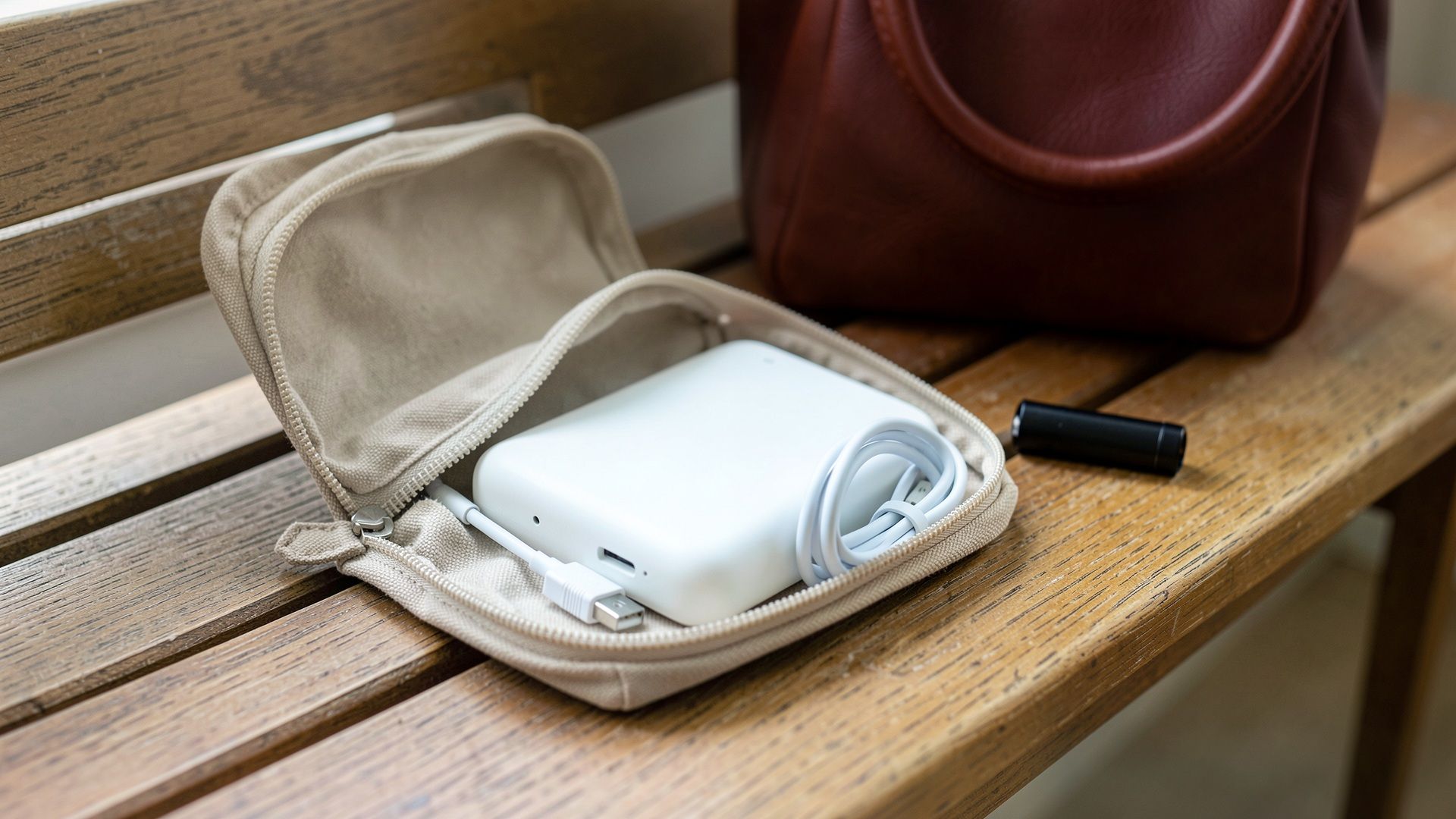
Purse or day-bag example: leave those same everyday essentials in familiar places and group chosen small extras in one transfer pouch. That could mean tissues, a few bandages and a compatible cable, with a power bank only when your actual day calls for one. Keep urgent care and frequently reached items separately accessible if needed. One pouch is a transfer aid, not a rule that everything must share a compartment.
A cable alone helps only when a suitable power source is available. If adding a bank, choose compatible equipment and a place protected from crushing, punctures, moisture and contact with keys or other metal objects. Keep it away from medicine conditions it could compromise. Do not charge a phone or bank inside the pouch or bag. For ordinary charging, take intact, nonrecalled equipment to a firm, flat, ventilated surface away from combustibles while awake and present. Our power-bank safety guide explains the setup and model-specific storage instructions.
Do not use or charge a damaged or recalled bank. For a known cold, stable suspect device, seek manufacturer and local hazardous-waste advice, not one last charging check. Excessive or increasing heat, active swelling, hissing, fumes or smoke call for a different response: move away, get people out and call emergency services from safety. Do not touch, move or unplug a failing bank. Oregon's battery guidance distinguishes charging precautions from escaping a battery fire.
Make the transfer harder to forget
Choose a home for the pouch in each bag you actually use. Then make a normal change of bags: move the pouch, wallet, keys and any separately carried care supplies. Check the old bag's small pockets. A pouch cannot transfer the inhaler or glasses case you stored elsewhere.
With the new bag packed, retrieve your contact note and light without emptying it onto a counter. Check that the closure works normally and that the load does not interfere with walking, sitting or using mobility equipment. If access is awkward or the load is uncomfortable, rearrange it or remove optional extras. These are practical observations, not a safety certification or a reason to push through discomfort.
Check the destination too. A workplace, school or event may restrict objects or bags; check its current policy directly. No knife or weapon is necessary to follow this approach. Keep useful, permitted items rather than building the whole arrangement around a tool you cannot take inside.
Subtract after an ordinary week
Try a week of noticing what you use, borrow, forget or struggle to find. This is our suggested observation period, not an official standard. A phone note is enough: “cable stayed home,” “light buried,” or “moved pouch but forgot care case.” Fix the access or transfer problem before buying another item.
For an illustrative example, someone who already carries a phone, keys and wallet might add a contact note and light, then remove a duplicate pen and unused adapters. Someone with prescribed supplies might need more space and keep those supplies separate. Neither arrangement is more prepared simply because it is smaller. These are examples, not tested loadouts.
Unused does not mean unnecessary. Keep emergency medicines and other required care even if you never needed them that week. Remove optional duplicates or objects with no credible task, not protection you personally depend on. Food, water and weather protection may also be necessary for your day; a tiny pouch does not replace them or cover an extended delay.
Reset after use, not just by the calendar
Replace used supplies promptly. As a suggested monthly reminder, check packaging, relevant expiry dates and contact numbers; inspect the light, cable and bank and follow their instructions. The month is our reminder idea, not an official maintenance interval. Medication changes, damage, recalls and a manufacturer's charging schedule require action sooner when applicable.
Before leaving today, put required care in its proper place, choose one genuinely useful gap to fill, and remove one optional duplicate. Close the bag and locate the things you will need first. The payoff is fewer forgotten essentials and less digging, not a promise that a small kit can handle every emergency.
Editorial note
The pocket and purse layouts are adaptable examples, not an official kit standard or tested loadouts. The week and month reminders are editorial suggestions. Follow your individual care plan, medicine labels, device instructions and destination rules; a small everyday kit does not replace emergency help or supplies for a longer disruption.
Article recap
- Choose items for real daily jobs, starting with what you already carry. Required care comes before pouch size.
- Group suitable extras for transfer, but keep urgent care accessible and batteries protected. Never charge inside the pouch.
- Use a week to spot optional duplicates, not discard emergency care. Replace used supplies promptly; check instructions and dates.
Sources and further reading
- FEMA / Ready.gov: Create Your Family Emergency Communication Plan (July 2015)
- Think It Through: Managing the Benefits and Risks of Medicines — U.S. Food and Drug Administration, accessed Nov 2026
- Storing your medicines — MedlinePlus / A.D.A.M., accessed Nov 2026
- Medicine safety and children — MedlinePlus / A.D.A.M., accessed Nov 2026
- Oregon State Fire Marshal: Rechargeable Battery Safety
Read next

Questions readers askFrequently asked questions
No. Start with your existing pockets or bag and give each essential a reliable place. A small transfer pouch can group optional extras, but required care may need separate access or storage. Change the arrangement if it cannot close normally or is uncomfortable; do not omit care to keep a smaller bag.
No. A suggested week of observation helps identify optional duplicates and awkward access, not prove that emergency supplies are unnecessary. Keep prescribed emergency medicines and other individually required care even when unused. Consider the actual day before removing food, water or weather protection.
Do not combine different medicines in one bottle or shared tin. FDA guidance favors original labeled containers whenever possible. If these are awkward to carry, ask your pharmacist about a suitable labeled option and exact storage requirements. An ordinary pouch does not provide temperature control. Keep medicines accessible according to your care plan and out of reach of children.
Replace used supplies promptly and act on care changes, damage or recalls when they occur. A monthly reminder is our editorial suggestion, not an official standard: review dates and contacts, inspect supplies and follow device-specific storage and charging instructions. Do not wait for that reminder when something needs attention.
Comments
Leave a comment
No comments yet. Be the first to comment!