Collapse & conflict
When Card Payments Go Down: How to Keep Buying What Matters
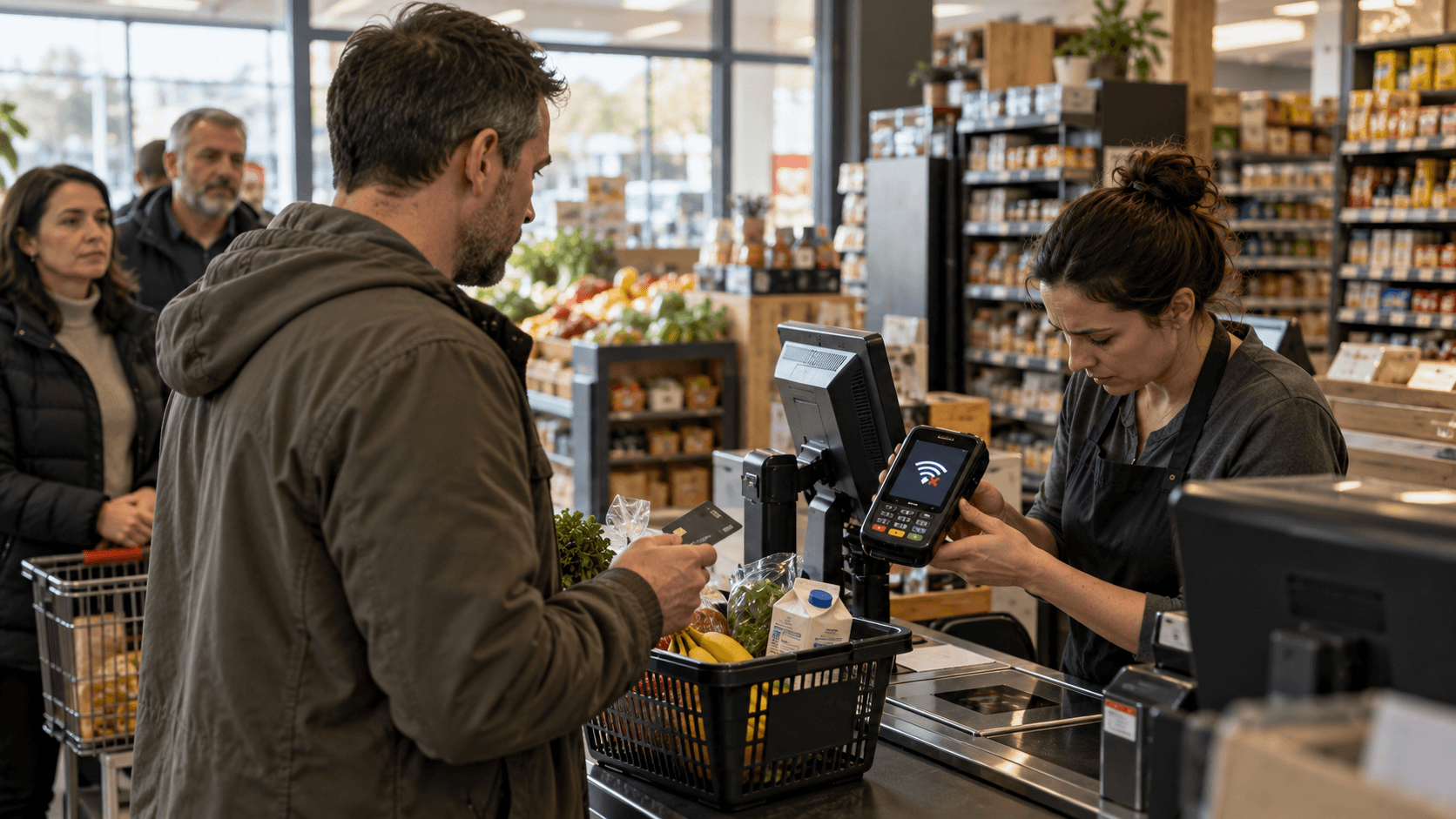
A card reader times out while you are buying groceries. The cashier cannot immediately tell whether payment went through. Your next move is not necessarily a...
Quick answer
Ask staff whether checkout is working and whether your sale completed. If the result is unclear, check the merchant's record and your usual banking app if available before repeatedly submitting or changing payment methods. Pending does not settle the question. Ask which alternatives the store accepts, buy only urgent essentials, and keep payment evidence. Prepare a small, affordable cash backup, not a large withdrawal.
A card reader times out while you are buying groceries. The cashier cannot immediately tell whether payment went through. Your next move is not necessarily another tap or a trip to an ATM. First establish what happened to this purchase, then choose a workable way to buy what you need.
A failed checkout alone does not tell you whether the problem is your card, the store or a wider service interruption. You do not need to diagnose the whole system. You need to know whether the sale completed, what the merchant can accept now, and whether the purchase can wait.
Ask about this sale before trying again
Tell staff what the reader displayed and ask: “Does your checkout record show that this sale completed, failed or is still uncertain?” Then ask whether other payments are working. A receipt or the merchant's transaction record is more useful than guessing from a frozen screen.
If the outcome is unknown, ask staff to check before repeatedly submitting the payment or switching to cash or another card. Check your own bank's existing app or known website if accessible, too. Compare the merchant, amount and time, but do not treat an app entry as the whole answer about the sale.
Chase explains pending transactions as charges not yet fully processed. Pending does not necessarily mean your checkout failed or completed. Chase also recognizes duplicate charges and charges after paying with cash or another card as possible dispute issues. That is a reason to check an uncertain attempt, not a blanket rule against retries.
If staff confirm the attempt failed or was cancelled and can explain how to proceed, follow that guidance while keeping the evidence. There is no universal retry delay. If an essential purchase cannot wait and the first attempt remains unresolved, explain this to staff, agree how to handle payment, and retain proof of both attempts.
Choose an alternative the store can actually accept
Ask which payment methods are working before offering another one. Cash may help only if the merchant is operating and accepts it. It cannot reopen a closed shop, restore a powered-down fuel pump or make unavailable stock accessible. Ask about change before committing to a cash purchase.
An already-owned card from a different bank may be worth considering if the problem appears specific to your first issuer and the merchant can accept the other card. Check the uncertain first transaction before switching. A different-bank card is not a dependable answer to a broken store terminal or a shared payment-network outage, and you do not need to open another account for this plan.
Do not assume a phone wallet, bank app or ATM is an independent backup. Any of them may be unavailable, and offline payment is not something to count on without confirmation from the merchant. A failed attempt is a prompt to ask what works, not to cycle through every device you own.
Your issuer's official service-status page may help if reachable. NatWest's service-status page, for example, reports on its own services and maintenance. That is provider-specific information, not a diagnosis of every bank or retailer. Staff may know which tills work without knowing the cause of the interruption.
Keep the purchase small and necessary
Separate what your household needs now from what can wait. Food for the next meal, necessary medicine, baby supplies or fuel for an essential journey may deserve attention before a routine shopping basket. Buy the minimum that meets the immediate need rather than adding items because checkout is uncertain.
For nonurgent goods, postponing the purchase may be simpler than making another payment attempt. If another shop is a reasonable option, check that it is open, has what you need and accepts a method you can use before travelling, if you can reach it. Follow local safety instructions; neither cash nor an apparent outage justifies an unsafe trip.
For future shopping, start with what is already at home. Our guide to planning an emergency grocery run around actual household needs covers pantry checks and familiar, affordable foods. Filling an ordinary pantry gap during normal shopping can reduce the need for an urgent purchase later. It does not guarantee stores, delivery or safe travel will be available.
Keep enough evidence to resolve uncertainty
Keep the receipt, purchase amount, date and time, merchant name, and any cancellation or alternative-payment proof. Note what staff said about the original attempt. If you contact the merchant or issuer later, record whom you reached and the response. Keep these records private rather than posting screenshots containing financial details.
For a suspected duplicate or other purchase error, ask the merchant to check its record. If it remains unresolved, contact your own issuer through a verified channel and follow its process. Chase's dispute guidance supports checking transaction details and keeping contact records, but its credit and debit procedures differ. Do not assume every issuer handles pending transactions the same way or that you must wait for every pending charge to post before asking for help.
Suspected unauthorized activity is different from an uncertain purchase you made. Report it promptly through your issuer's verified fraud or support channel rather than waiting to finish a merchant-error sequence. If your usual channel is unavailable, use another contact method published by your issuer when you can access it; immediate contact is not guaranteed.
Prepare a modest cash backup and trusted contacts
Ready.gov's financial-preparedness guidance recommends a small amount of cash at home in a safe place, including small bills, because ATMs and cards may not work during a disaster. Choose an amount your household can afford without compromising bills or essentials. Build it gradually if needed; this is not a reason for a large withdrawal or a cash stash in a vehicle.
Keep a minimal contact note with your bank's name and a trusted support number, separate from securely stored financial records. Do not carry full account numbers, PINs, passwords or copies of complete cards as a checkout backup. The CFPB's disaster-preparation guidance recommends safe document storage and password protection for online copies. Access planning should not create a new exposure.
Use the number on your actual card, an existing banking app or a known official website you enter yourself. Do not follow an unsolicited “restore payments” link, share security credentials, or transfer money because an unexpected caller says it will fix access. A payment problem is not a reason to trust a new contact.
Keep your phone charged. Check charging connections only with known-good, manufacturer-compatible equipment and an undamaged, usable power bank, following its instructions. Our guide to saving phone battery while staying reachable explains the trade-offs without cutting off needed calls or alerts. The aim is a few usable options: establish the sale's status, choose an accepted payment method, keep proof, and postpone what can wait.
Editorial note
This guide covers household purchases during payment interruptions, not investment decisions or a prediction of recovery time. Merchant acceptance, bank procedures and local conditions vary. Provider examples are not universal rules; follow your own issuer's instructions and local safety guidance.
Article recap
- Ask staff whether the sale completed before repeatedly submitting or changing payment methods when the result is unclear.
- Pending does not prove checkout failed or completed. Follow your own issuer's guidance for unresolved payments.
- Cash helps only where the merchant is operating and accepts it. Keep a modest, affordable reserve securely at home.
- A different-bank card may help with an issuer-specific problem, not a failed terminal or shared network outage.
- Keep payment evidence private. Report suspected unauthorized activity promptly through a verified issuer channel.
- Buy the minimum needed now, postpone nonurgent goods, and check another store before travelling if safe and possible.
Sources and further reading
Read next

Comments
Leave a comment
No comments yet. Be the first to comment!