Power outages
How to Test Your Power Outage Kit Without Turning Off the Power
A flashlight in a drawer and a power bank in a cupboard are useful only if you can find them and make them work. A household kit check turns those assumption...
Quick answer
Keep household power and essential systems running. Find your stored supplies, operate portable lights, check the actual phone with its packed cable and power bank, receive a local radio broadcast, and retrieve paper contacts. Record what worked, what failed and what remains untested. Fix gaps and repeat the affected check. A charging indication or clear broadcast does not establish battery endurance, alert delivery or network availability during an outage.
A flashlight in a drawer and a power bank in a cupboard are useful only if you can find them and make them work. A household kit check turns those assumptions into observations: which light you can operate, which cable charges your phone, and which instructions are missing.
Leave the electricity on. This is a check of supplies you already own, not an endurance exercise or a rehearsal of every possible outage. Work in normal, safely lit conditions, pause whenever needed, and finish with a short repair list rather than a readiness score.
Keep the household running
Tell anyone at home what you are checking. Leave the refrigerator, freezer, heating, cooling, alarms, pumps, internet equipment and powered medical devices operating normally. Do not switch breakers, cut mains power, disconnect a UPS, disable alarms or shut off water. Keep walkways clear and do not create a darkness challenge.
Use portable electric lights, not flames. The American Red Cross recommends flashlights rather than candles and warns against using generators, outdoor stoves or heaters indoors. Generator, fuel and combustion tests are outside this routine.
Choose the tasks that fit your mobility, vision, hearing and energy. Someone can bring an item to a seated user, read a label aloud or help operate a control. Assistance is part of the plan, not a failed check. Stop using anything visibly damaged or behaving abnormally; consult its instructions before further use.
Start where your supplies actually live
Begin from the place you normally spend time, without first arranging every item on a table. Find your portable light, radio, phone power bank and cable, paper contacts, drinking water, ready-to-eat food and any needed manual opener. Note supplies kept in a different cupboard or bag so the kit does not depend on one person's memory.
Can the intended user reach, recognize and retrieve each item without moving heavy boxes or blocking a route? Record inaccessible storage separately from equipment failure.
If a basic item is absent, mark it missing rather than improvising an unsafe substitute. Our home power outage supplies guide can help prioritize that gap. Check what you own before buying anything.
Give each light a real task
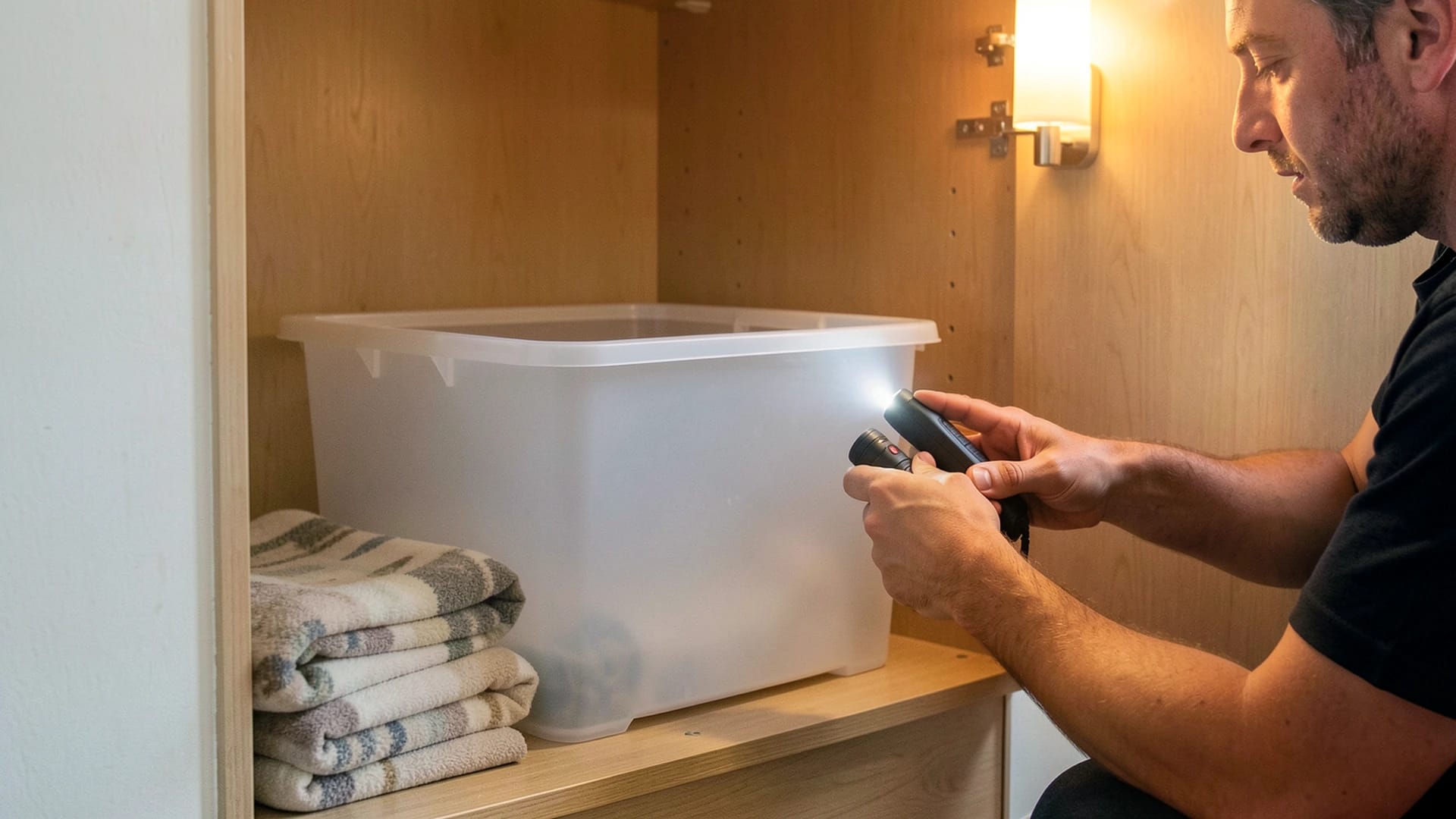
Operate the light from its stored condition. Find the switch and select a useful setting. With room lights still on, use it to illuminate a contact card or kit label at the place you expect to sit or work. For a headlamp, check that the intended user can put it on comfortably and reach its controls.
A useful result is specific: the light switches on, its controls are understandable, and the user can read the chosen information with it. Record confusing controls or an awkward fit. Check spare battery compatibility against the label or manual.
Let another intended user try if practical. Return the light to a reachable place. This checks controls, not blackout visibility or runtime.
Check the phone, cable and bank together
Find the cable stored for the phone you actually use. Check the bank and cable for visible damage before connecting them. Using the equipment instructions, connect that phone to the intended output port on the bank with that exact cable. Keep the setup in view while checking it.
Look for the phone's charging indication. A plug that fits or a bank display showing charge does not show that this connection is supplying power to the phone. If charging is not indicated, record the combination as unresolved and follow the device instructions to identify the problem. Do not force connectors or modify cables.
Record the working phone, cable and port. Keep the cable with the bank or label its location. Check each intended phone combination separately.
This observation is not a battery-capacity measurement. It cannot promise a number of full charges or hours of use. For decisions about a different backup type, see power banks versus portable power stations. Do not turn this check into a full-discharge exercise or connect a consumer battery to medical equipment as an experiment.
Hear information and find the paper plan
Operate your portable radio according to its manual and try to receive a useful local broadcast where you expect to listen. Note the station or channel, location, and controls needed to reach it. If it normally uses mains power, leave that connection alone; record any battery-only operation you have not checked as untested.
For U.S. NOAA Weather Radio, the National Weather Service notes that reception can vary from room to room. Try another accessible listening spot or antenna position as the manual permits. Outside the U.S., identify the local official broadcasts and alert services relevant to your area. Our emergency radio guide covers the equipment questions in more detail.
A clear broadcast is a reception result, not proof that alert settings are correct or emergency alerts will arrive. Check programming against the radio instructions separately. Likewise, a message sent today cannot prove that mobile or internet service will work during a regional outage.
Retrieve the paper contact list and check that details are current. The Red Cross recommends keeping a paper copy. Agree how to check in and where to meet if communication fails. Send only an agreed, ordinary message to a support contact, never a test call to emergency dispatch.
Review food, water and personal needs
Identify a meal you can access without electricity and find its opener if needed. Inspect stored food and water packaging and review the relevant dates and storage instructions. Ready.gov's kit guidance recommends replacing expired items and reassessing household needs each year. Record missing supplies or unclear dates for follow-up; do not heat cans or test a camping stove indoors.
Leave refrigeration running. Check where your food-safety instructions and any stored thermometer are, without opening the refrigerator to stage an outage. Include pet supplies and access needs in the inventory.
For powered medical devices or refrigerated medicines, the task is to find the care plan and the right provider contacts. Ready.gov advises discussing an outage plan with your medical provider. Do not interrupt treatment, change medication storage or test backup equipment on a person. Confirm backup procedures with the care team, supplier and manufacturer, including a powered destination if staying home becomes unsuitable.
Explain the next step, then close the gaps
Ask another capable household member to explain where the first light is, how the phone connection works and where the paper contacts are. Ready.gov recommends practicing your household plan. If you live alone, walk through those same actions yourself and discuss any help you would need with an agreed support person. Do not assume they will be available without asking.
Name a fallback for an unavailable item: another accessible light, another information source, or a person you can contact for help. Identify a safe powered destination and how you would reach it if home no longer meets your needs. Checking a kit does not make staying home appropriate in every outage.
Keep a brief record for each task:
Item or task and the exact result observed.
Status: worked for this check, failed, missing or untested.
Fix needed, person responsible and a chosen completion date.
Retest date and what happened after the fix.
Retest the failed step, not just the replacement item. A new cable still needs to be checked with the intended phone and bank. If you cannot perform a check safely, leave it marked untested and arrange suitable help.
Restore used supplies, recharge and store equipment according to its own manual, and return everything to its known location. Choose a next review date and revisit affected checks after a phone, cable, device or household need changes. The optional free home power outage checklist can help with the inventory; no signup or download is needed to do this routine.
Finish knowing what worked today, what remains untested and who will fix each gap.
Editorial note
This routine checks ordinary kit access and basic operation under normal conditions. It is not a capacity test or a guarantee of emergency service. Follow equipment manuals, medical-provider advice and local official guidance for your household's needs.
Article recap
- Keep normal lighting, household power, alarms and essential equipment running throughout the check.
- Check the intended user and actual equipment combination, not just whether an item is present.
- Charging indications and radio reception do not prove endurance, emergency alerts or outage network availability.
- Record failed, missing and untested tasks; assign fixes and retest the affected steps.
- Follow equipment manuals for charging and storage, and providers' advice for medical backup planning.
Sources and further reading
- Power Outage Safety | American Red Cross — accessed Oct 2026
- Ready.gov: Power Outages — accessed Aug 2026
- Ready.gov: Build a Kit — Ready.gov, accessed Aug 2026
- Ready.gov: Make a Plan — Ready.gov, accessed May 2026
- NWR Reception | National Weather Service — accessed Oct 2026
Read next


Questions readers askFrequently asked questions
No. Check portable supplies in normal, safely lit conditions while household power remains on. Leave alarms, refrigeration, heating, cooling, internet equipment and medical devices operating. Do not switch breakers or disconnect a UPS for this routine.
No. It shows a charging indication for that phone, cable and bank connection at the time of the check. It does not measure the bank's capacity or establish a number of charges or hours. Follow the equipment instructions for charging and storage, and treat endurance planning as a separate task.
It shows that you received that broadcast in that location at that time. It does not establish battery-only operation if the radio remained on mains power; leave its mains connection untouched for this routine and mark unchecked battery operation untested. It does not establish that alert programming is correct or that emergency alerts will arrive. Follow the receiver manual for settings and check the local official broadcast or alert services appropriate to your area.
Walk through the actions you can perform safely and identify any assistance you need. Arrange an agreed support contact rather than assuming someone will be available. Adapt tasks to your access needs and record anything you cannot safely check as untested.
Ready.gov recommends reassessing household kit needs each year and replacing expired supplies as needed. Choose a review date that suits your household and repeat affected checks after equipment or needs change. Follow each manufacturer's instructions for recharge and storage; there is no single interval in this routine for every battery.
Comments
Leave a comment
No comments yet. Be the first to comment!